
Every scrap yard eventually confronts the same question: which shearing machine actually pays for itself? As induction furnaces and steel mills push for denser, more consistent charge material, the choice of processing equipment has shifted from a routine purchase into a decision that shapes plant economics. What follows sets three widely used shearing technologies side by side — the multi-blade shear, the box shear, and the container shear — and uses real specification data to show why compression-based shearing is the sounder investment for most operations.
The Scrap Processing Challenge
Raw scrap arrives in every shape and density imaginable: pipes, structural sections, machinery frames, sheet offcuts, and mixed light-to-heavy loads. Left as it is, this material is costly to transport, slow to charge, and uneven to melt. The job of a shearing machine is to cut and compress it into dense, uniformly sized pieces that move cleanly from yard to furnace.
How a shear achieves that varies considerably from one design to the next, and the technology a yard selects bears directly on output density, throughput, operating cost, and — the figure that matters most — cost per ton processed. The three machines examined here look broadly similar on paper, yet they behave very differently on the floor.
Multi-Blade Shear — Density and throughput, at the lowest cost per ton
The multi-blade shear pairs lid compression with a top-clamp ram, forcing scrap into a reinforced chamber where several blades cut it in a single stroke. Because the charge is compacted before it is cut, the machine copes comfortably with a broad mix of feed, from medium sections through to heavy structural scrap, reducing it to pieces under 500 × 500 mm and handling up to five pieces in one chamber load. Output density sits at roughly 1,000 kg/m³, and operating cost runs as low as ₹90 per ton — the lowest of any shear in this comparison.
Key Components
▪ Compression Chamber — heavy-duty steel chamber with lid and top-clamp rams
▪ Multi-Blade Cutting Head — several blades shearing at once for shorter cycle times
▪ Feed Cylinder — draws scrap into the chamber for continuous processing
▪ Hydraulic Power Pack — pumps, valves, and reservoir driving every compression and shear function
▪ PLC Control Panel — automatic and manual cycle control with integrated safety interlocks
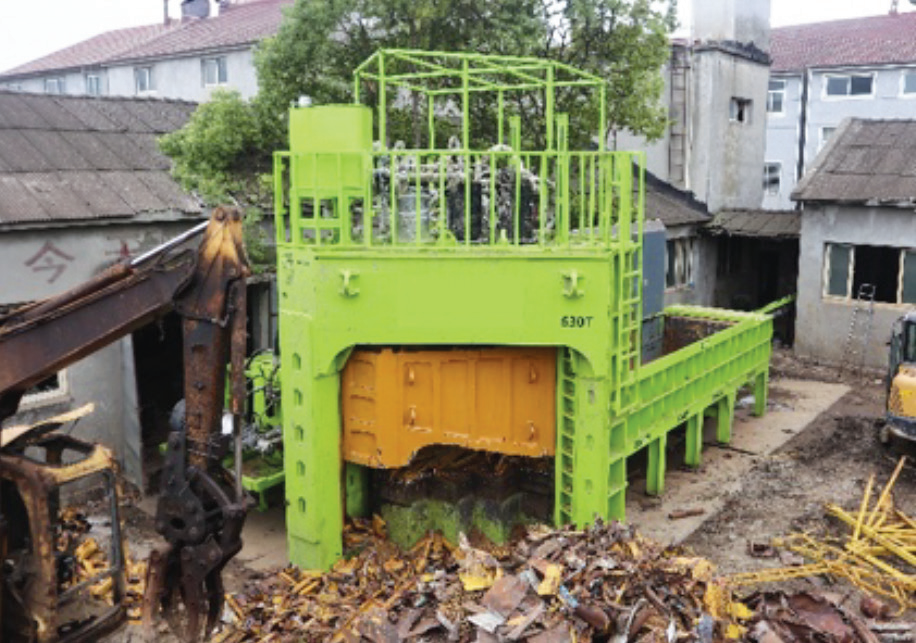
Box Shear — Most dense output in the range
The box shear adds a third axis of compression. Lid, side, and top-clamp rams consolidate scrap from every direction before the blades make their cut, producing some of the densest output of any shear category — around 1,200 kg/m³. That three-way action lets it take on the same medium-to-heavy, mixed feed as the multi-blade shear while cutting oversized material down from 1,200 mm to 500 mm in a single chamber load. Where maximum density is the priority, no machine in the range performs better.
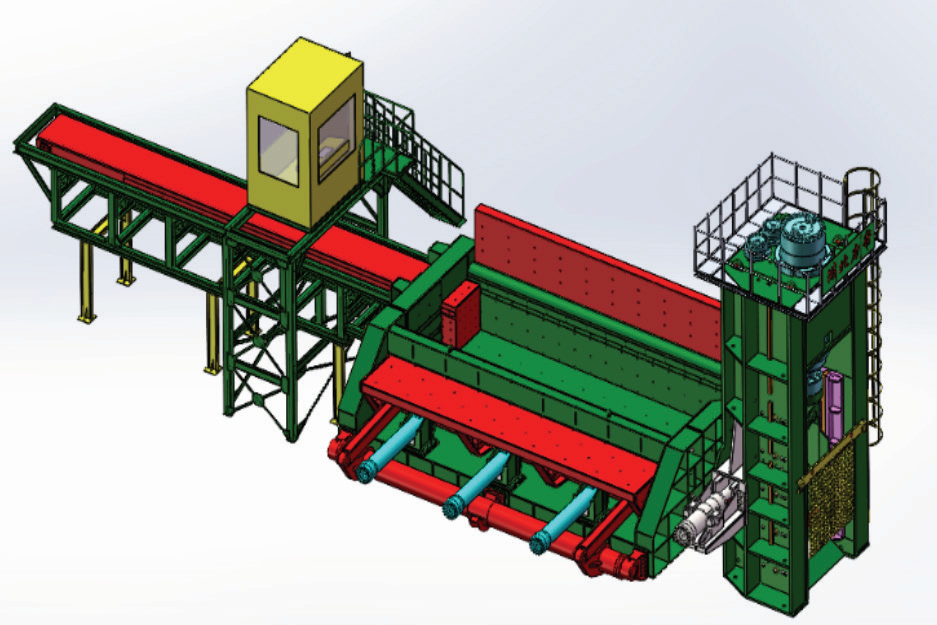
Key Components
▪ Compression Chamber — heavy-duty steel chamber with lid, side, and top-clamp rams
▪ Multi-Blade Cutting Head — multiple blades shearing the compacted charge in one stroke
▪ Feed Cylinder — draws scrap into the chamber for continuous processing
▪ Hydraulic Power Pack — pumps, valves, and reservoir driving every compression and shear function
▪ PLC Control Panel — automatic and manual cycle control with integrated safety interlocks
Container Shear — Simple and compact, at lower density
The container shear works on a simpler principle. Scrap is loaded into a closed, container-style chamber, compressed from the sides, and cut with a single horizontal stroke. It is mechanically straightforward and easy to run, but that simplicity carries trade-offs.
With side compression alone — and none of the lid or top- clamp action of the compression shears — the container shear settles at a noticeably lower output density of around 700 kg/m³. Lower density means more truckloads and more charging cycles to move the same tonnage, and processing capacity trails the other two machines at every comparable model tier.

Key Components
▪ Side Compression Rams — two horizontal cylinders compressing scrap inward
▪ Shear Blade Assembly — single shear head cutting the compressed charge
▪ Hydraulic Power Pack — pumps, motors, valves, and oil reservoir
▪ Safety Interlocks — emergency stops, proximity sensors, and limit switches
Head-to-Head: Density, Throughput, and Cost per Ton
Set against equivalent shear-force model tiers, the two compression shears consistently out-process the container shear while producing denser, more furnace-ready material. The table below shows how the three compare on the factors that shape
day-to-day economics.
| Factor | Multi-Blade Shear | Box Shear | Container Shear |
|---|---|---|---|
| Method | Lid+top clamp | Lid+side+top clamp | Side only |
| Output density | ~1,000 kg/m³ | ~1,200 kg/m³ | ~700 kg/m³ |
| Operating cost | ₹90 / t | ₹120 / t | ₹100 / t |
| Capacity range | 10–35 tons/hr | 10–35 tons/hr | 8–20 tons/hr |
| Scrap suitability | Medium, heavy, mixed | Medium, heavy, mixed | Medium & light only |
| Pieces per cycle | Up to 5 per load | Single piece per load | Single-piece |
The pattern holds across the range. At every matching model size, the compression shears move more tonnage per hour and pack it denser than the container shear. The multi-blade shear does so at the lowest operating cost of the three; the box shear trades a slightly higher running cost for the densest output in its class.
For yards handling mixed or heavier streams, both translate into better furnace charging efficiency and lower freight per ton — savings that usually outweigh any difference in operating cost.
The Verdict
The container shear remains a reasonable entry point for yards handling only light-to-medium scrap on a limited budget; it is simple, affordable, and easy to run. But for operations that need higher throughput and denser, more consistent output across a wider range of material, the multi-blade and box shear are the sounder long-term investment. In the end, the right choice follows the scrap — the heavier and more varied the stream, the stronger the case for compression-based shearing.
About Dev Energy
Dev Energy is a trusted provider of end-to-end scrap processing solutions for secondary steel melting plants, spanning shearing, scrap feeding, and fume extraction systems. Backed by more than two decades of engineering, over 200 completed projects, and a 100,000+ sq. ft. manufacturing facility, Dev Energy helps steel producers lower processing costs while improving scrap quality and furnace performance.
