
Why Now?
The world is in need of processes and technologies that reduce the global carbon footprint. Every two decades steel mills need upgradation and reinvestments and in this current cycle of refurbishment, there is a chance to use low-carbon technologies that can upgrade two-thirds of the current production capacity to Green Steel before 2030. This presents a critical window of opportunity to retrofit the existing blast furnaces (BF-BOF) and Natural Gas Reforming based Direct Reduction of Iron (DRI- EAF) vertical shaft Kins with low-carbon technologies. One of the proven and available technologies is Circulating Fluidised Bed (CFB) Coal gasification with ready to use Carbon capture, Utilisation and Storage (CCUS).
What is Green Steel?
Global recognized organizations like WSA and IEA have not yet clearly defined the term green steel, instead, they define low- carbon steel in their climate change policy paper as “Steel that is manufactured using technologies and practices that enables the emission of significantly lower CO2 than conventional
production”

Currently as per global statistics, almost 71% of steel is currently being made using the BF-BOF process, with 29% produced by the EAF method. The conventional BF-BOF & Horizontal DRI Kiln routes are dependent on High-Carbon intensity raw material like coal and coke.
As you can see below, the Carbon Dioxide emissions from the conventional route are in the range of 2.2 – 2.6 t of CO2 /ton of steel.
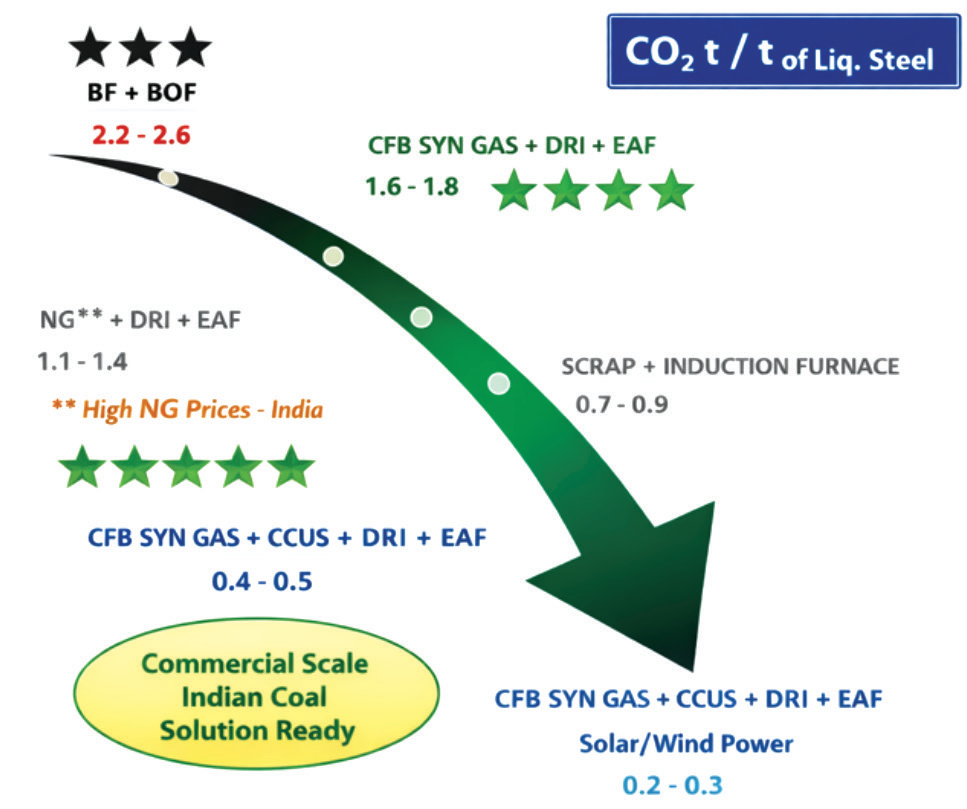
Low-Carbon intensity green steel is central to achieving global decarbonization targets, as the fast-growing steel industry accounts for about 7–9% of global CO2 emissions. Now, Carbon Boarder Adjustment mechanism (CBAM) as is getting implemented globally and for steelmakers the higher CO2 intensity means higher costs directly impacting competitiveness and margins. The newer technologies can bring down the carbon dioxide emission to 0.2 – 0.3 t of CO / ton of steel.
The simplest technology that can reach the stated target is to use vertical DRI kiln where the reduction is by Synthetic Gas or SYN GAS from coal Gasification.
Basics of Low-Carbon Steel Making
As you can see from the diagram, the reduction has to happen with removal of oxygen molecules by use of carbon or hydrogen and heat has to come from either chemical of electrical energy. The key to resolving the carbon emission questions is to shift to processes that emit least carbon dioxide.
Coal Gasification generating SYN gas is the best bet for the future of steel making.

How SYN Gas is Path Forward?
Coal Gasification makes SYNGAS which is a mixture of hydrogen (H2), carbon monoxide (CO), and methane (CH4) (75 – 80% mol) with some carbon dioxide (CO2) made from coal with use of oxygen and steam firring. The basic gasification reactions are
1. C + H O → CO + H (Hydrogen)
2. C + O → CO (Carbon Monoxide)
3. C + 2H → CH (Methane)
The SYN gas generated through Coal Gasification is then cleaned and cooled through multiple stages to achieve the final state where it can be used as reduction gas for the vertical DRI kiln. Dev Energy has partnered to provide the proved technology of Circulating Fluidised Bed (CFB) gasification for the production of the SYN gas and transformation of the same to the desired specifications of stell industry.
CFB Technology – How it Works?
Circulating Fluidized Bed (CFB) technology is a coal gasification process where solid fuels are converted into a SYN gas at high temperature in presence of oxygen and steam. Coal is processed through grinding, sorting, and/or drying to bring the feedstock < 10 mm particulate size.
Crushed coal is pneumatically conveyed into a pressurized lock hopper, which feeds it into the CFB gasifier. The coal combines with oxygen and steam as gasification in the fluidized bed at temperature of 1000 C to provide high carbon conversion and
o
Coal Gasification generating SYN gas is the best bet for the future of steel making.
How SYN Gas is Path Forward?
Coal Gasification makes SYNGAS which is a mixture of hydrogen (H2), carbon monoxide (CO), and methane (CH4) (75 – 80% mol) with some carbon dioxide (CO2) made from coal with use of oxygen and steam firring. The basic gasification reactions are
1. C + H O → CO + H (Hydrogen)
non-slagging of ash. Ash is removed by gravity from the gasifier and is discharged into a system for depressurization and disposal. The gasifier maintains a low level of carbon in the bottom ash discharge stream.
Fines carried over from the fluidized bed are separated from the syngas prior to heat recovery and syngas cleanup in the cyclone and bag filter. The product syngas is essentially free of tars and oils due to the temperature and residence time of the gases in the fluidized bed, simplifying downstream heat recovery and gas cleaning operations.
Fines carried over from the fluidized bed are separated from the syngas prior to heat recovery and syngas cleanup in the cyclone and bag filter. The product syngas is essentially free of tars and oils due to the temperature and residence time of the gases in the fluidized bed, simplifying downstream heat recovery and gas cleaning operations.

CFB Technology Features & Advantages
CFB gasification design using waste heat recovery process, which can recover the heat from syngas to produce high temperature and high-pressure steam along with oxygen preheating resulting in overall optimum thermal efficiency.
CFB is more fuel-flexible with utilization of low-rank and other high-ash coals. It offers higher efficiency than competing gasification technologies. As fines carried over from the fluidized bed are separated from the syngas prior to heat recovery and syngas cleanup.
There are proven commercial scale plants operating in China and ready solution is available from basic engineering, detailed engineering, and EPC solutions

Why CFB?

Integration CFB – Vertical Kiln DRI
Dev Energy has completed the detailed study and can offer solution as required by all global vertical shaft DRI technology Licensors making it wide adaptability for overall technical and commercial optimisation to make Green Steel.
Case Study: 0.5 MTPA DRI – Vertical Shaft DRI Kiln
The solution is to tailor the SYN gas composition to the requirements of the DRI technology Licensors. Below are the details of requirement for the stated case study:
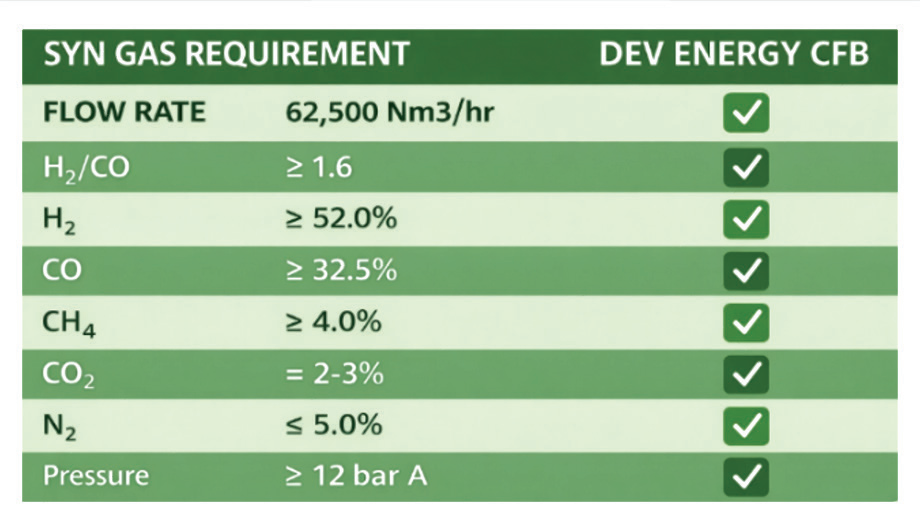
The SYN gas produced from the CFB gasification is transformed through the Water Shift reactor to balance the H2/CO ratio. The technology has the complete flexibility of H2/CO ratio such as 1.1, 1.6 or even future -proof 100% Blue H2.
The water shift reaction generates carbon dioxide and the amine wash technological process is used to remove the CO2 from the SYN gas. The same process also eliminates the sulphur present in form of H2S in the gas making is as per the requirement stated above.

CFB gasification adopts oxygen-enriched gasification, and the N content in syngas can be effectively controlled below 5% or lower. CFB gasification pressure is high avoiding any downstream compression requirement, and the CH content in the syngas can
4
be up to Controlled ideal for DRI steel-making feedstock.
The final simulated performance of the DRI kiln is enumerated below.

CO is threat and not COAL
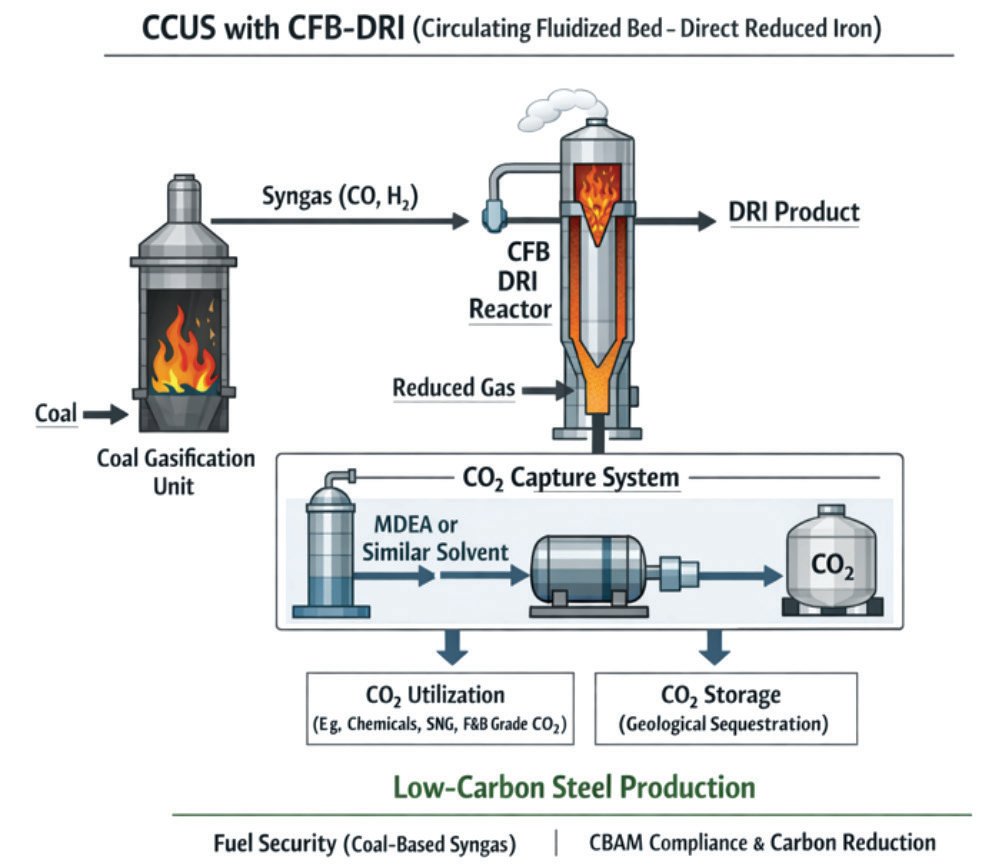
To drastically lower process CO2 emissions, CCUS with CFB- DRI (Circulating Fluidized Bed – Direct Reduced Iron) combines carbon capture systems with CFB coal gasification. In order to produce low-carbon steel, CO is isolated from the reducing gas loop using MDEA. The same is either used to make chemicals or used as F&B grade CO2 or permanently stored. This arrangement aligns DRI operations with CBAM and future carbon pricing regimes while improving the plant economics.
National Policy Support
India being 2nd largest producer of crude steel, Government of India has started offing various mechanisms of Viability Gap funding (VGF) for Coal Gasification and for Carbon Capture Utilization and Storage (CCUS). Ministry of Coal (MoC) and Ministry of Steel (MoS) have both emphasized on Low-Carbon intensity green steel making through coal gasification.
Dev Energy – Rediness:
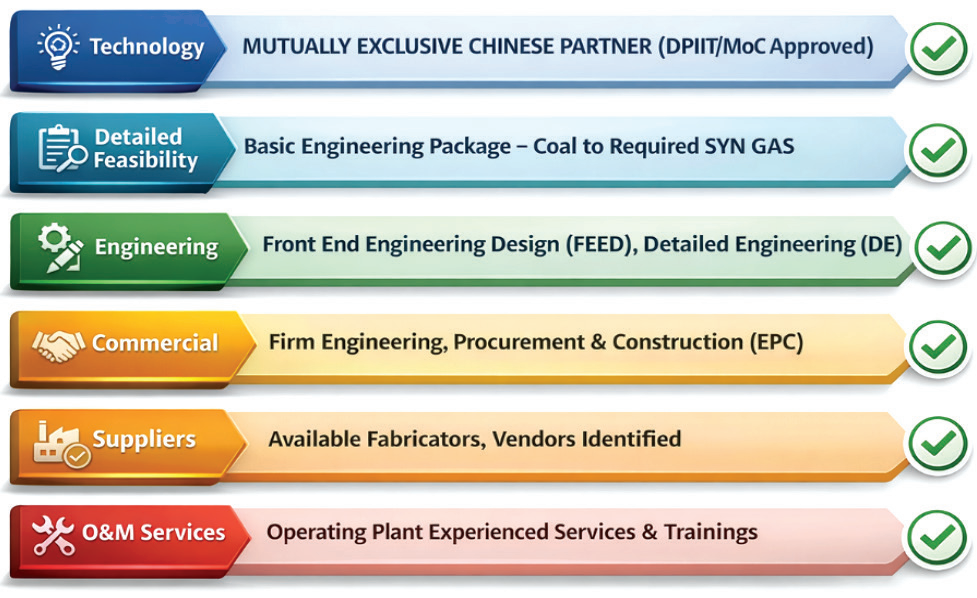
CFB coal gasification, optimally integrated into a vertical kiln-based downstream steel plant, will deliver green steel as shown below:

DEV ENERGY with its successful Turnkey EPC solution is ready with the complete design and implementation plan for the proven solution with exclusive partnerships already in place. We already have delivered for more than 23 years and are committed to Sustainable Low-Carbon intensity Green Steel Solutions. Dev Energy offering is through experienced & qualified team for Coal gasification and all other related infrastructure for the projects for DRI Vertical Kilns for Green Steel with committed after sales service and handholding till operational success.
