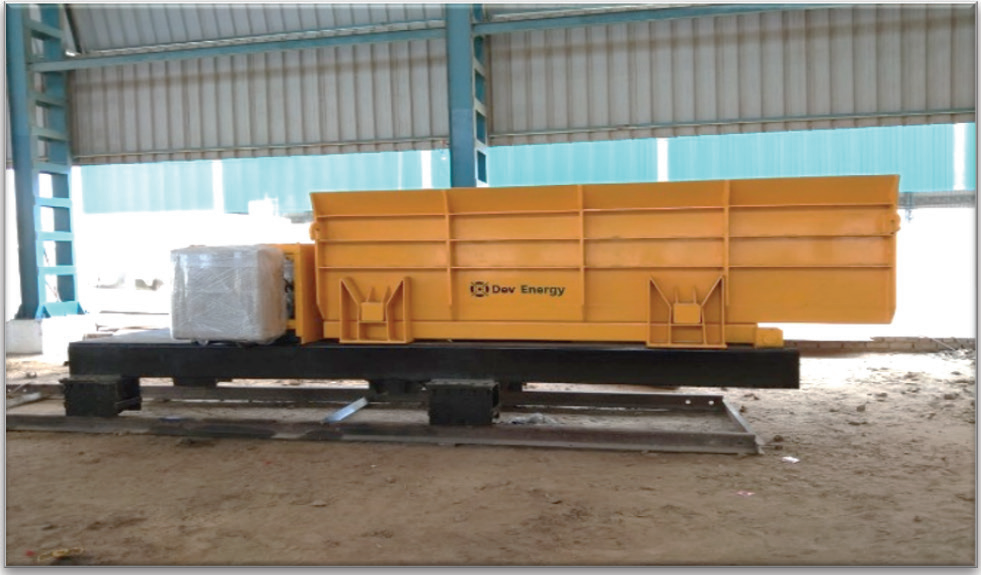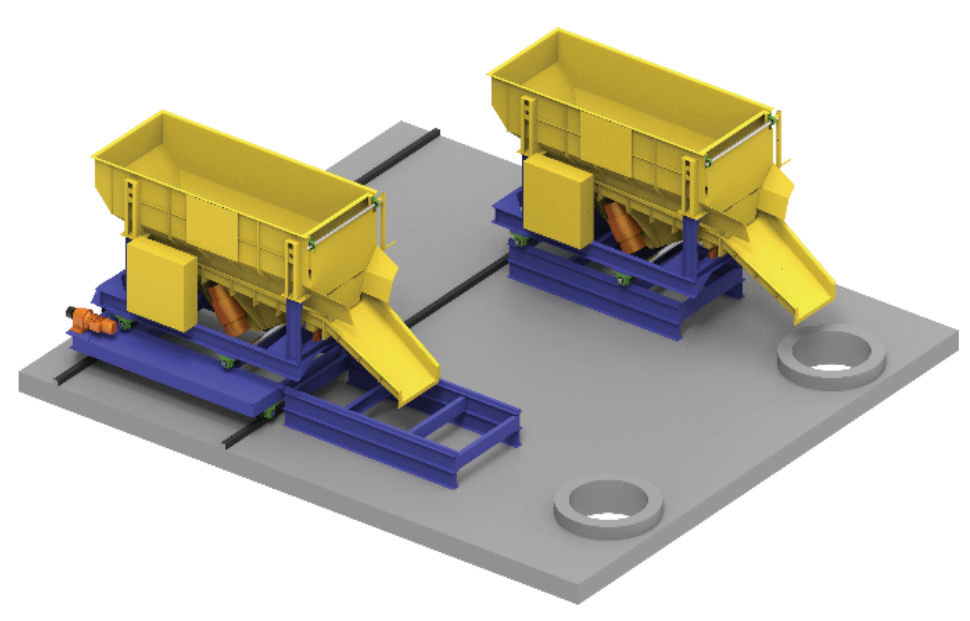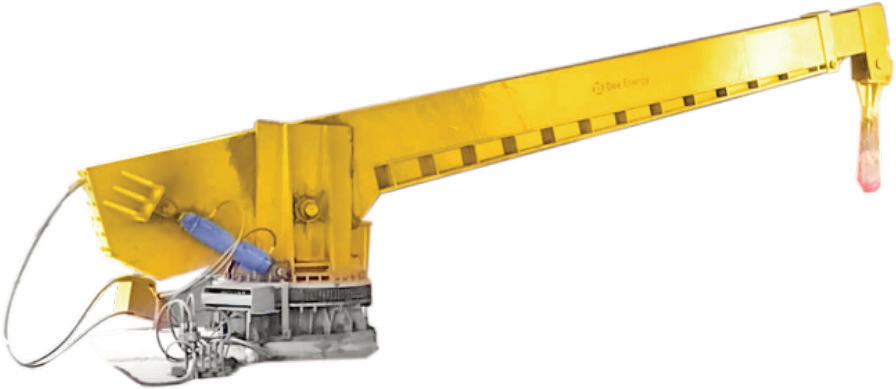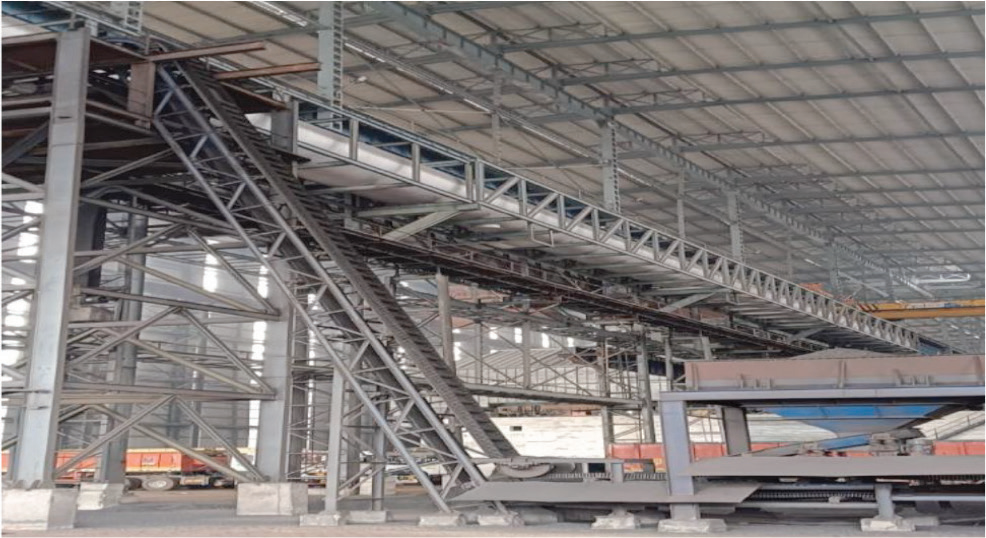
All Posts By

Mr Varun Jindal

The Shear Dilemma

By UncategorizedNo Comments

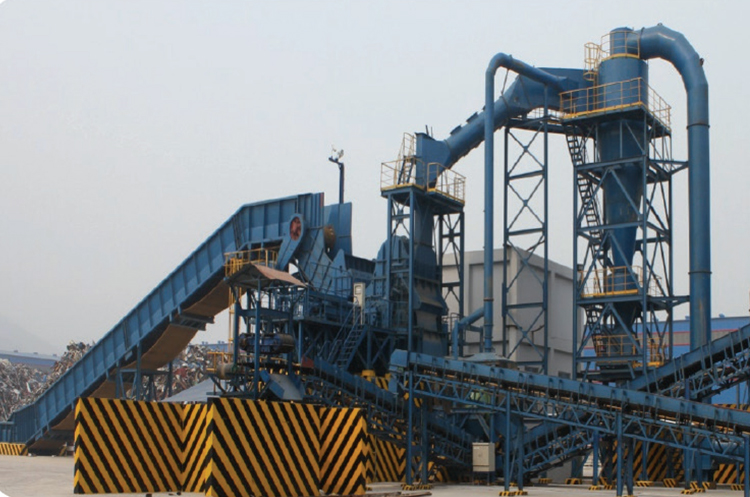
Every scrap yard eventually confronts the same question: which shearing machine actually pays for itself? As induction furnaces and steel mills push for denser, more consistent charge material, the choice of processing equipment has shifted from a routine purchase into a decision that shapes plant economics. What follows sets three widely used shearing technologies side by side — the multi-blade shear, the box shear, and the container shear — and uses real specification data to show why compression-based shearing is the sounder investment for most operations.

The Scrap Processing Challenge

Raw scrap arrives in every shape and density imaginable: pipes, structural sections, machinery frames, sheet offcuts, and mixed light-to-heavy loads. Left as it is, this material is costly to transport, slow to charge, and uneven to melt. The job of a shearing machine is to cut and compress it into dense, uniformly sized pieces that move cleanly from yard to furnace.
How a shear achieves that varies considerably from one design to the next, and the technology a yard selects bears directly on output density, throughput, operating cost, and — the figure that matters most — cost per ton processed. The three machines examined here look broadly similar on paper, yet they behave very differently on the floor.

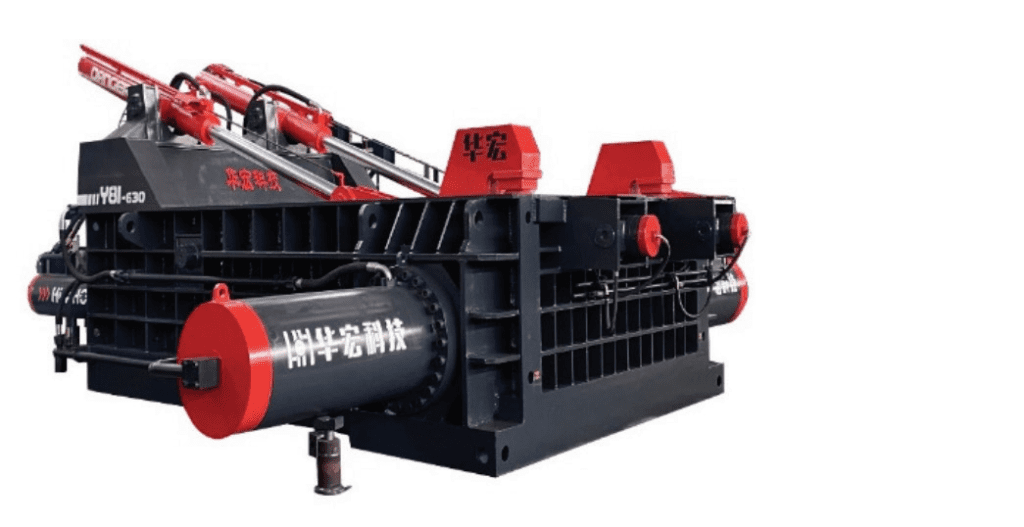
Multi-Blade Shear — Density and throughput, at the lowest cost per ton

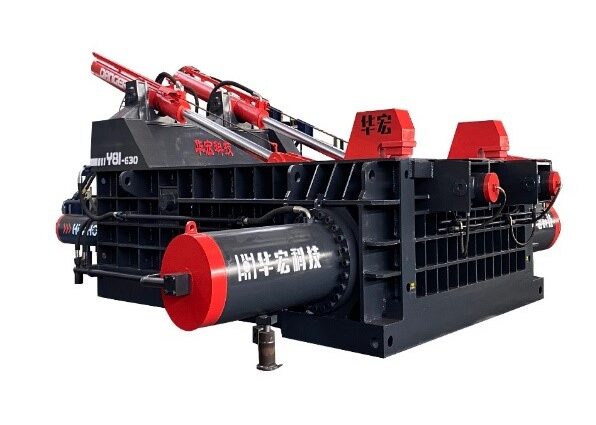
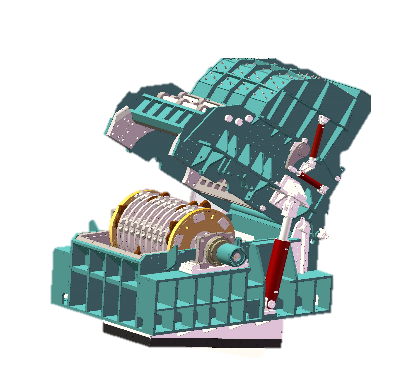
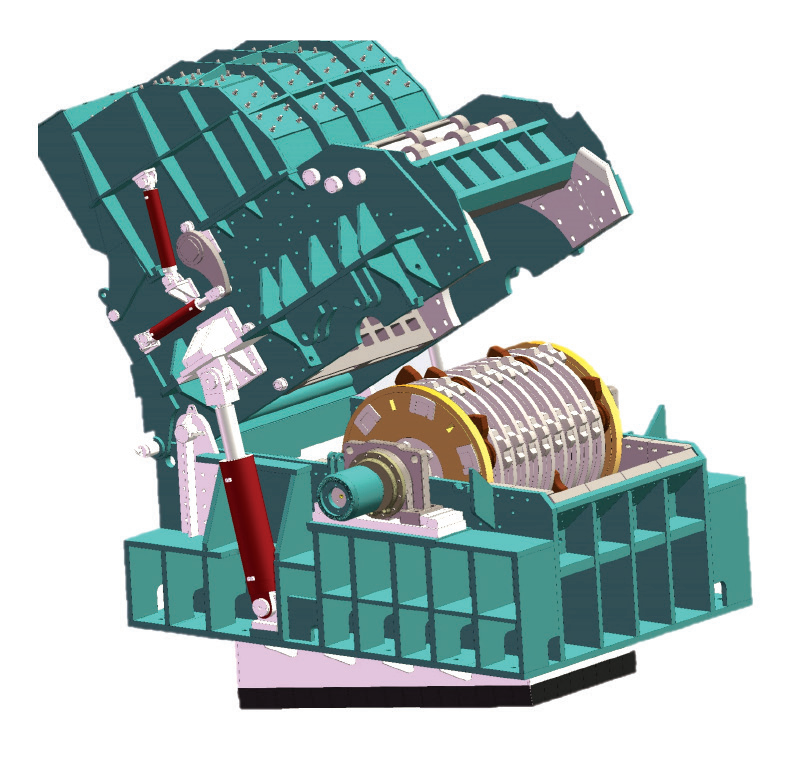
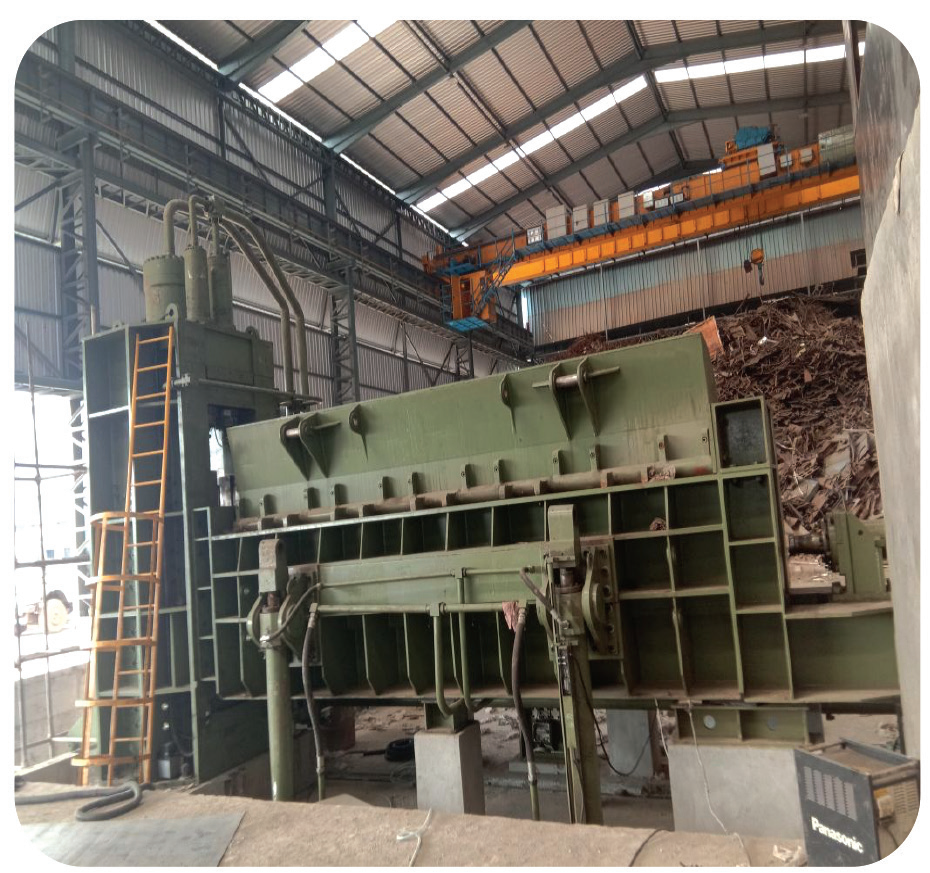
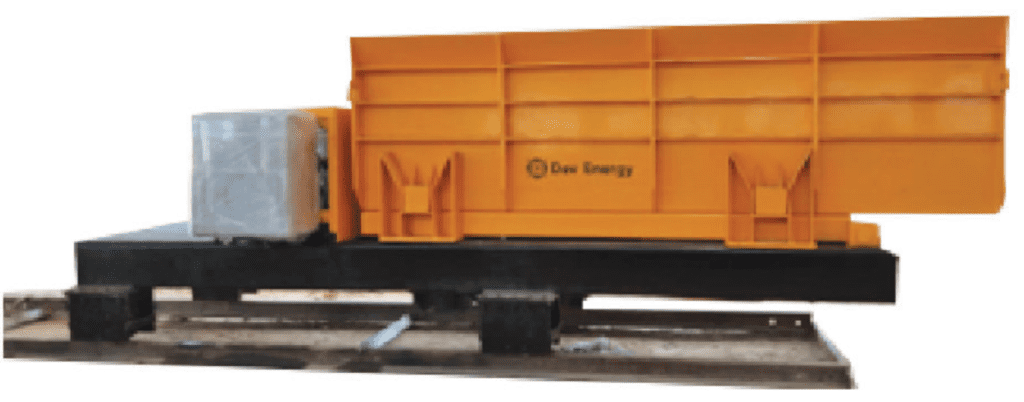
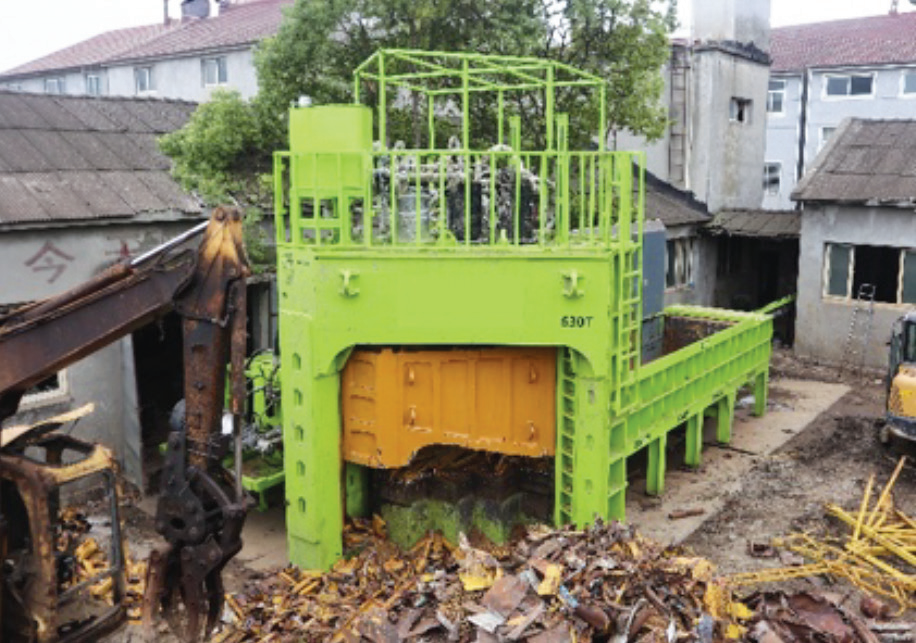
The multi-blade shear pairs lid compression with a top-clamp ram, forcing scrap into a reinforced chamber where several blades cut it in a single stroke. Because the charge is compacted before it is cut, the machine copes comfortably with a broad mix of feed, from medium sections through to heavy structural scrap, reducing it to pieces under 500 × 500 mm and handling up to five pieces in one chamber load. Output density sits at roughly 1,000 kg/m³, and operating cost runs as low as ₹90 per ton — the lowest of any shear in this comparison.

Multi-Blade Shear — Density and throughput, at the lowest cost per ton

The multi-blade shear pairs lid compression with a top-clamp ram, forcing scrap into a reinforced chamber where several blades cut it in a single stroke. Because the charge is compacted before it is cut, the machine copes comfortably with a broad mix of feed, from medium sections through to heavy structural scrap, reducing it to pieces under 500 × 500 mm and handling up to five pieces in one chamber load. Output density sits at roughly 1,000 kg/m³, and operating cost runs as low as ₹90 per ton — the lowest of any shear in this comparison.

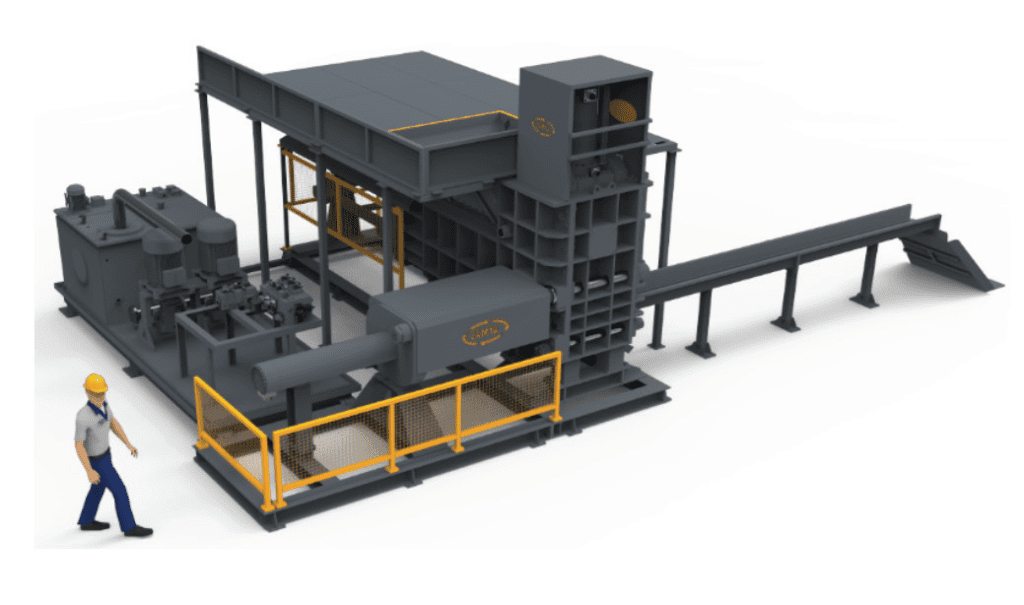
Key Components

▪ Compression Chamber — heavy-duty steel chamber with lid and top-clamp rams
▪ Multi-Blade Cutting Head — several blades shearing at once for shorter cycle times
▪ Feed Cylinder — draws scrap into the chamber for continuous processing
▪ Hydraulic Power Pack — pumps, valves, and reservoir driving every compression and shear function
▪ PLC Control Panel — automatic and manual cycle control with integrated safety interlocks

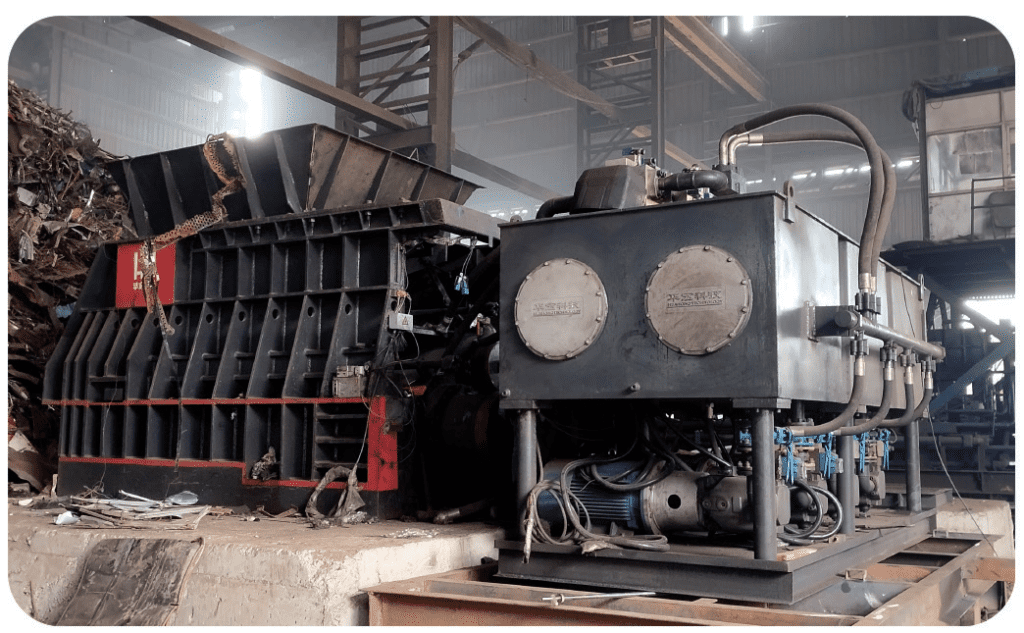
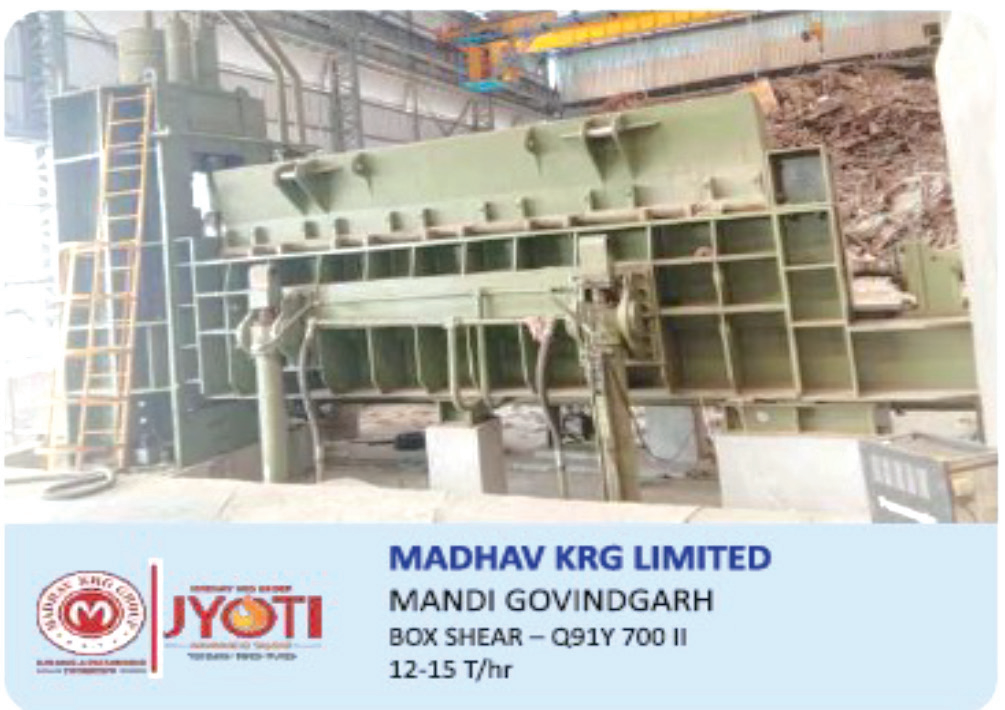
Box Shear — Most dense output in the range

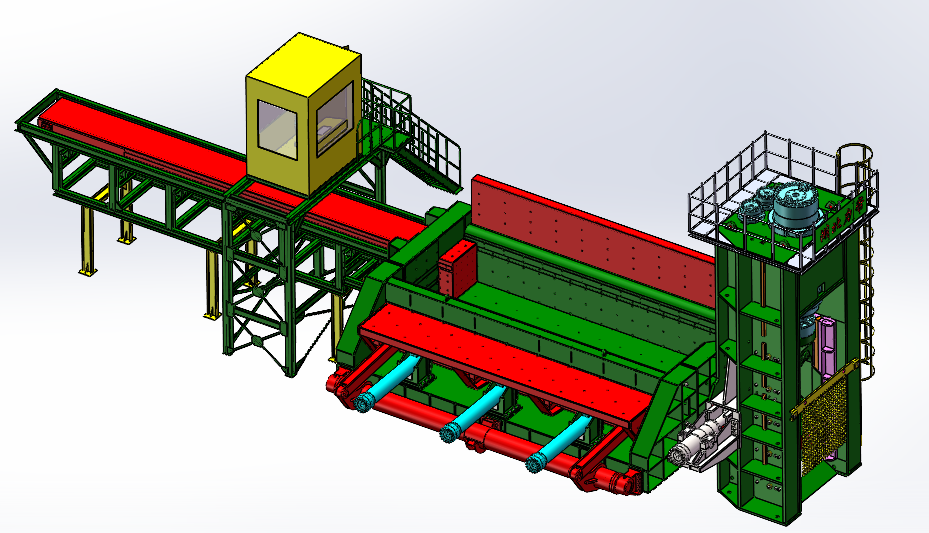
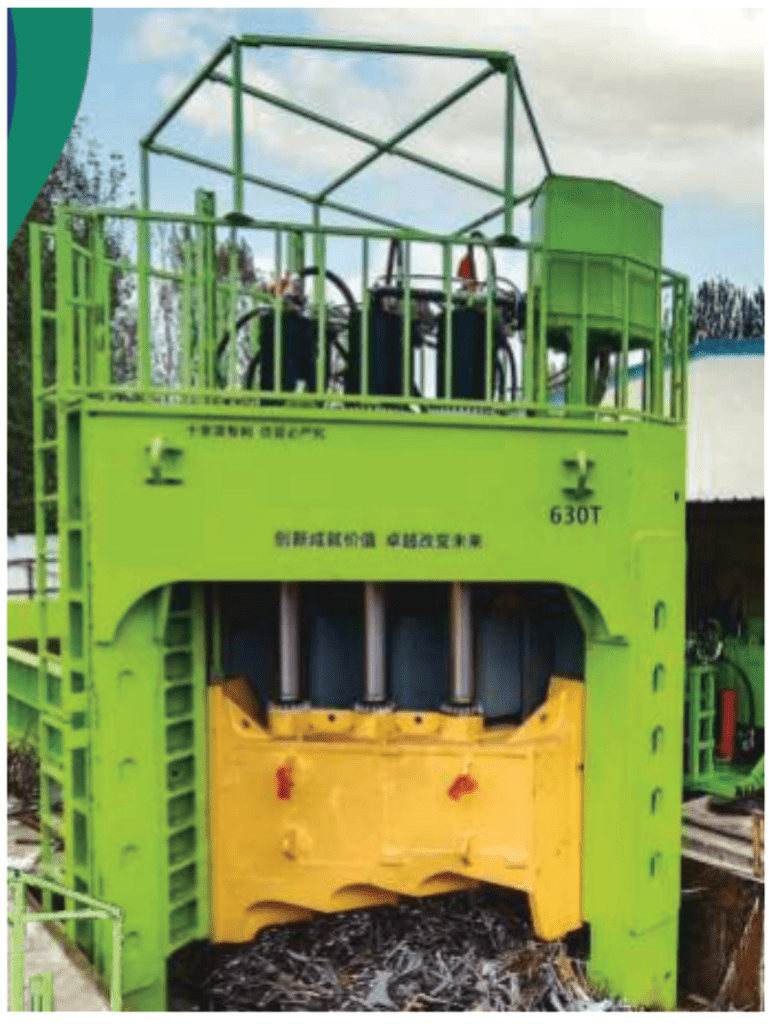
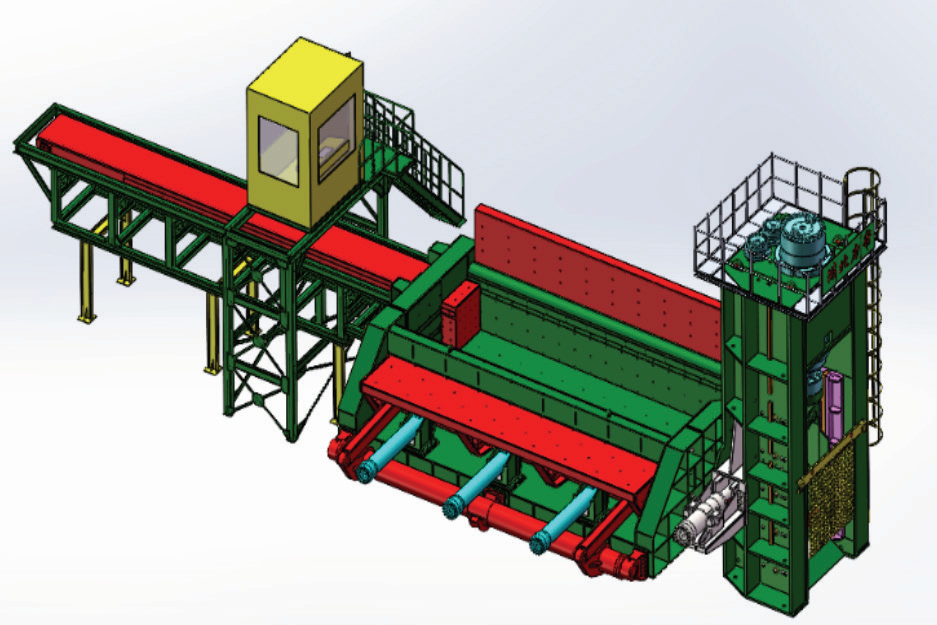
The box shear adds a third axis of compression. Lid, side, and top-clamp rams consolidate scrap from every direction before the blades make their cut, producing some of the densest output of any shear category — around 1,200 kg/m³. That three-way action lets it take on the same medium-to-heavy, mixed feed as the multi-blade shear while cutting oversized material down from 1,200 mm to 500 mm in a single chamber load. Where maximum density is the priority, no machine in the range performs better.
Key Components

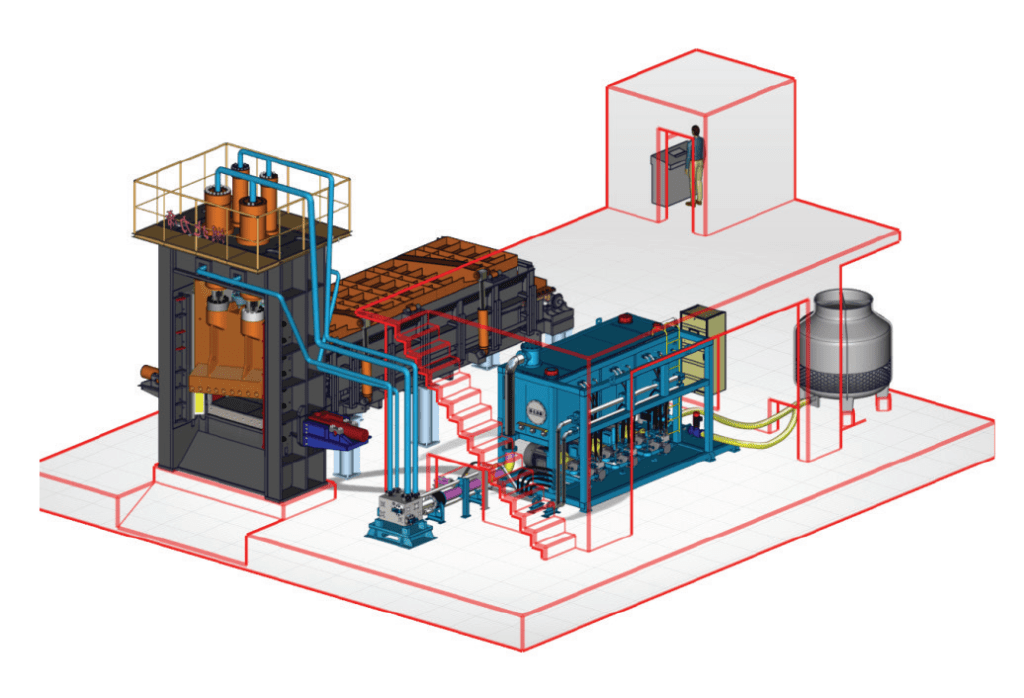
▪ Compression Chamber — heavy-duty steel chamber with lid, side, and top-clamp rams
▪ Multi-Blade Cutting Head — multiple blades shearing the compacted charge in one stroke
▪ Feed Cylinder — draws scrap into the chamber for continuous processing
▪ Hydraulic Power Pack — pumps, valves, and reservoir driving every compression and shear function
▪ PLC Control Panel — automatic and manual cycle control with integrated safety interlocks

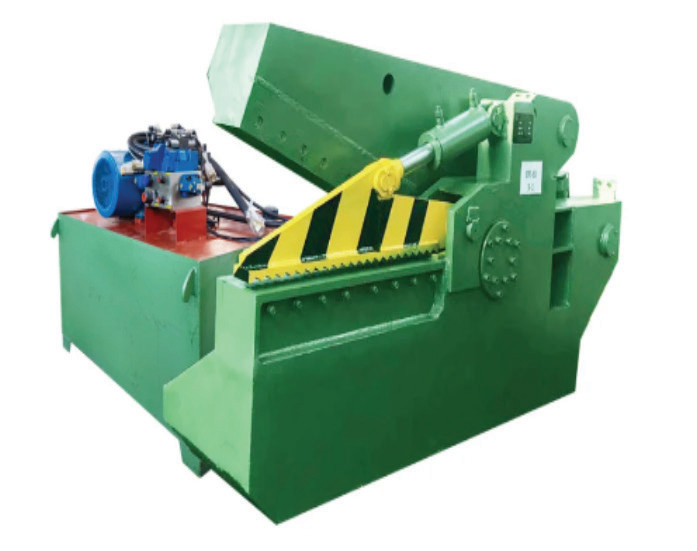
Container Shear — Simple and compact, at lower density

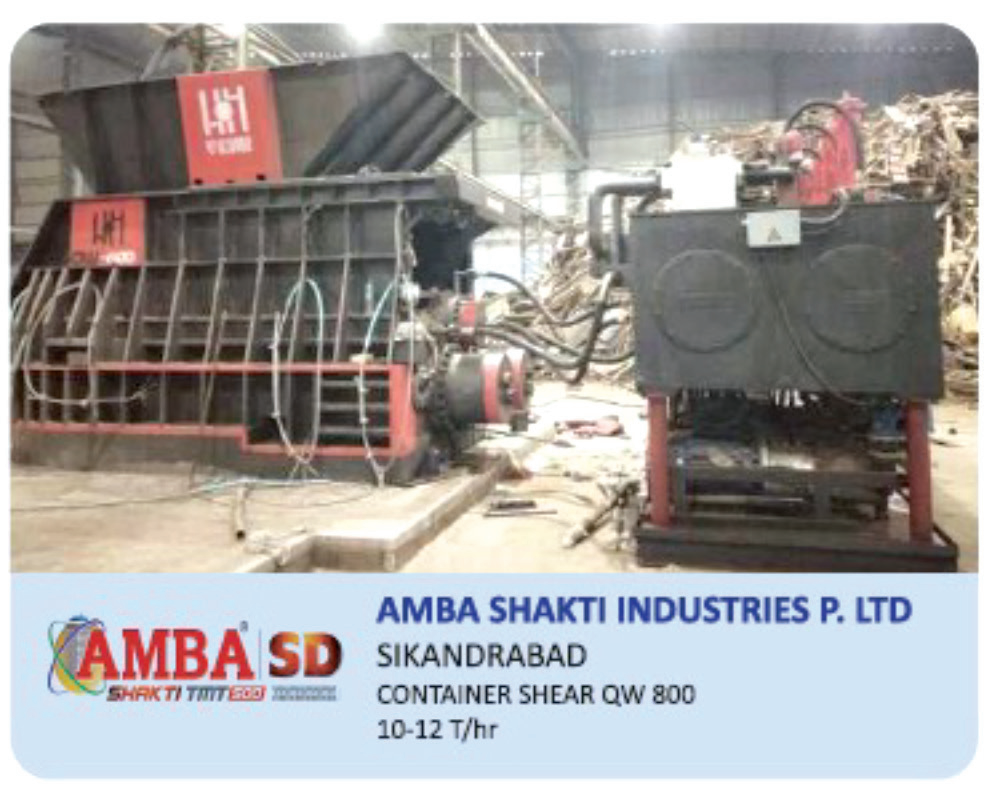
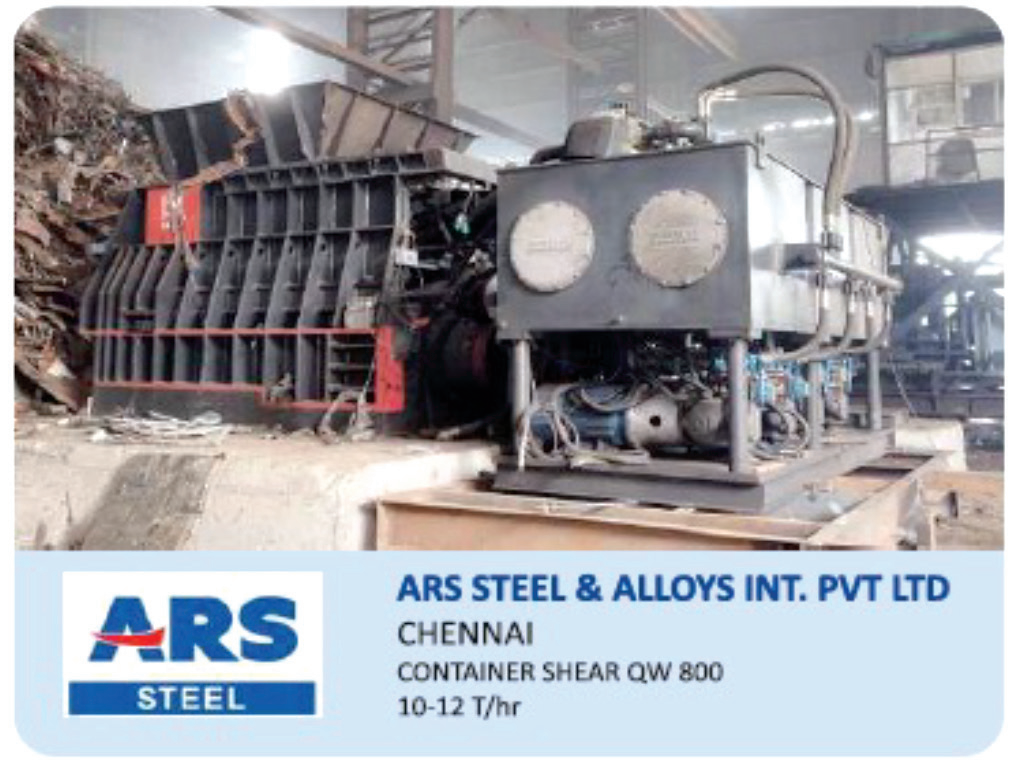
The container shear works on a simpler principle. Scrap is loaded into a closed, container-style chamber, compressed from the sides, and cut with a single horizontal stroke. It is mechanically straightforward and easy to run, but that simplicity carries trade-offs.
With side compression alone — and none of the lid or top- clamp action of the compression shears — the container shear settles at a noticeably lower output density of around 700 kg/m³. Lower density means more truckloads and more charging cycles to move the same tonnage, and processing capacity trails the other two machines at every comparable model tier.

Key Components

▪ Side Compression Rams — two horizontal cylinders compressing scrap inward
▪ Shear Blade Assembly — single shear head cutting the compressed charge
▪ Hydraulic Power Pack — pumps, motors, valves, and oil reservoir
▪ Safety Interlocks — emergency stops, proximity sensors, and limit switches

Head-to-Head: Density, Throughput, and Cost per Ton

Set against equivalent shear-force model tiers, the two compression shears consistently out-process the container shear while producing denser, more furnace-ready material. The table below shows how the three compare on the factors that shape
day-to-day economics.

Factor Multi-Blade Shear Box Shear Container Shear
Method Lid+top clamp Lid+side+top clamp Side only
Output density ~1,000 kg/m³ ~1,200 kg/m³ ~700 kg/m³
Operating cost ₹90 / t ₹120 / t ₹100 / t
Capacity range 10–35 tons/hr 10–35 tons/hr 8–20 tons/hr
Scrap suitability Medium, heavy, mixed Medium, heavy, mixed Medium & light only
Pieces per cycle Up to 5 per load Single piece per load Single-piece

The pattern holds across the range. At every matching model size, the compression shears move more tonnage per hour and pack it denser than the container shear. The multi-blade shear does so at the lowest operating cost of the three; the box shear trades a slightly higher running cost for the densest output in its class.

For yards handling mixed or heavier streams, both translate into better furnace charging efficiency and lower freight per ton — savings that usually outweigh any difference in operating cost.

The Verdict

The container shear remains a reasonable entry point for yards handling only light-to-medium scrap on a limited budget; it is simple, affordable, and easy to run. But for operations that need higher throughput and denser, more consistent output across a wider range of material, the multi-blade and box shear are the sounder long-term investment. In the end, the right choice follows the scrap — the heavier and more varied the stream, the stronger the case for compression-based shearing.

About Dev Energy

Dev Energy is a trusted provider of end-to-end scrap processing solutions for secondary steel melting plants, spanning shearing, scrap feeding, and fume extraction systems. Backed by more than two decades of engineering, over 200 completed projects, and a 100,000+ sq. ft. manufacturing facility, Dev Energy helps steel producers lower processing costs while improving scrap quality and furnace performance.
Coal Gasification: Driving Competitiveness Through Substitution of High-Cost Fuels like PNG, LNG, LPG, Propane, and Furnace Oil

By UncategorizedNo Comments

THE BIG PICTURE — WHY COAL GASIFICATION?

The Indian Industrial landscape is undergoing its most consequential energy transition in a century. There is huge shift of usage of conventional fossil fuels like Natural Gas, LPG, Propane or Furnace Oil to the usage of abundantly available coal in India. This conversion is happening through proven commercial scale available technological options on End application by using Coal Gasification route to create Coal Gas suitable as fuel. This offers the user long-term energy security along with economic benefits of de-risking the user from the fuel availability & price volatility shocks. This has created a once-in-a-generation window in India to fundamentally transform how India and the world produce steel, aluminium, ceramics, glass, chemicals and derivatives of same.

At the centre of this transformation sits a technology that is mature, commercially deployed, domestically adaptable, and strategically decisive: Coal Gasification. By converting India’s abundant coal reserves into a clean, high-quality Coal Gas coal gasification technology enables economic competitiveness of India’s most important industrial sectors without dependence on expensive, import-constrained Piped or Liquified Natural Gas, Liquified Petroleum Gas (LPG) and Furnace Oil.

PROGRESSIVE DEVELOPMENT - TECHNOLOGY

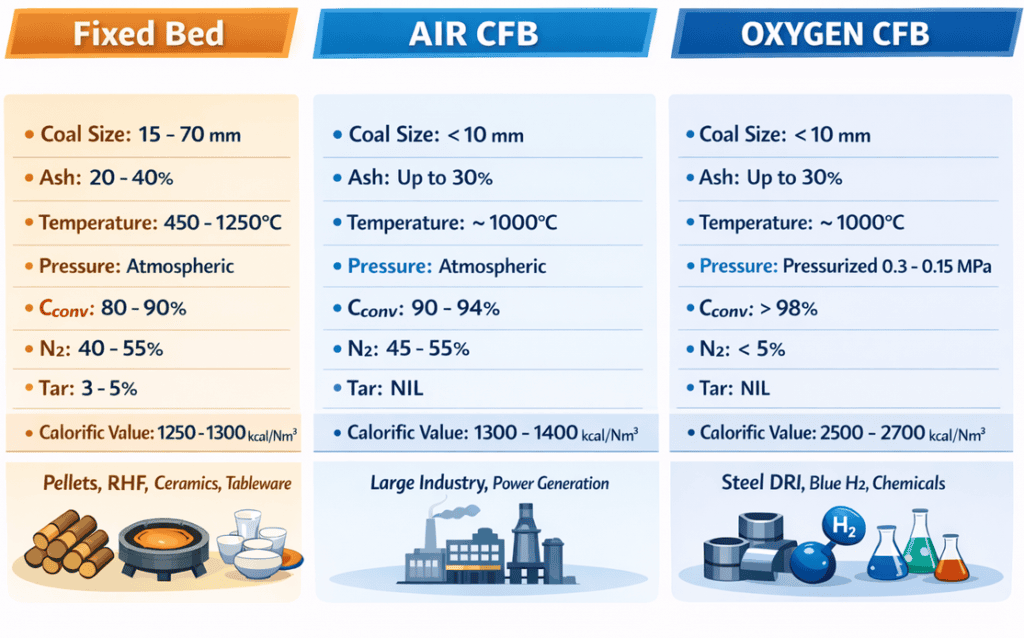
Coal emerging as the main INDUSTRIAL FUEL source in India has witnessed a journey from pilot to commercial scale applications in last two decades. The initial usage of Fixed Bed technologies has yielded huge benefits to Industry. Now, the latest Circulating Fluidised Bed Gasification technologies which having globally established itself is ripe for yielding benefits in India.

CORE COAL GASIFICATION TECHNOLOGIES

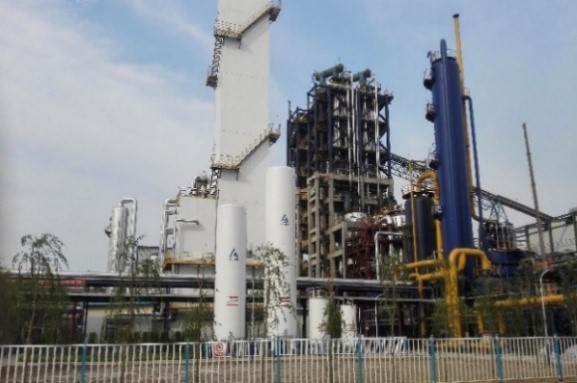
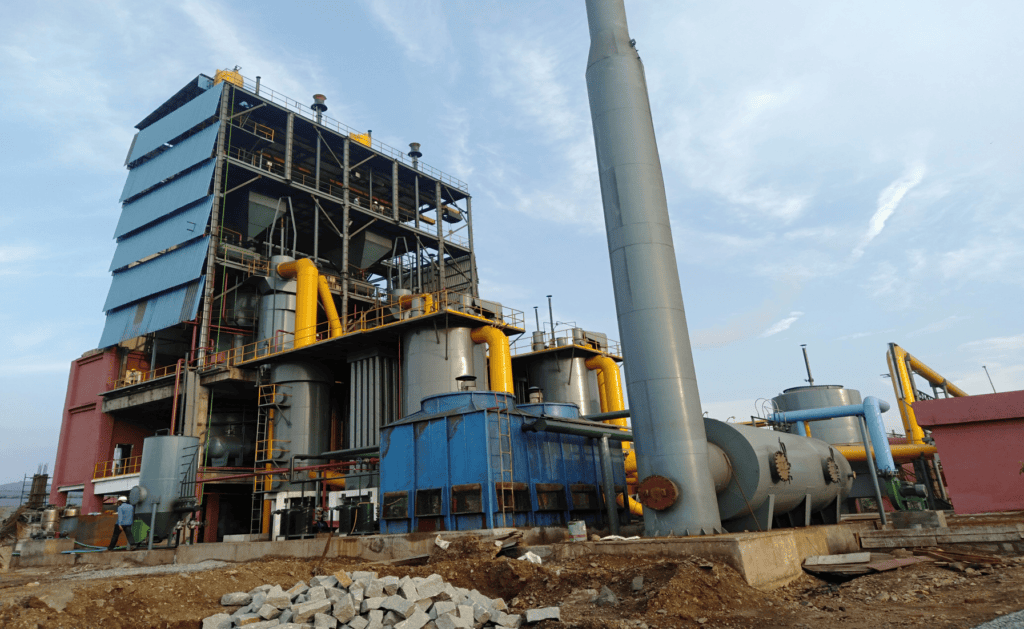
Coal Gasification at atmospheric pressure and with air as reagent is proven as the most technically suitable for generation of gas usable as fuel across all industries in India and Globally. Dev Energy, since 2003, has been pioneer inintroduction by of this technology in India in various industrial applications having cumulatively converted Indian coal over ~ 50 million tons into usable Coal gas as fuel.

MULTIPLE INDUSTRIES - APPLICATIONS

The Coal Gas generated from Indian coal which is then cleaned and cooled to be used as FUEL gas is used as a direct substitute to expensive, import-constrained Piped or Liquified Natural Gas, Liquified Petroleum Gas (LPG) and Furnace Oil in multiple industry segments.

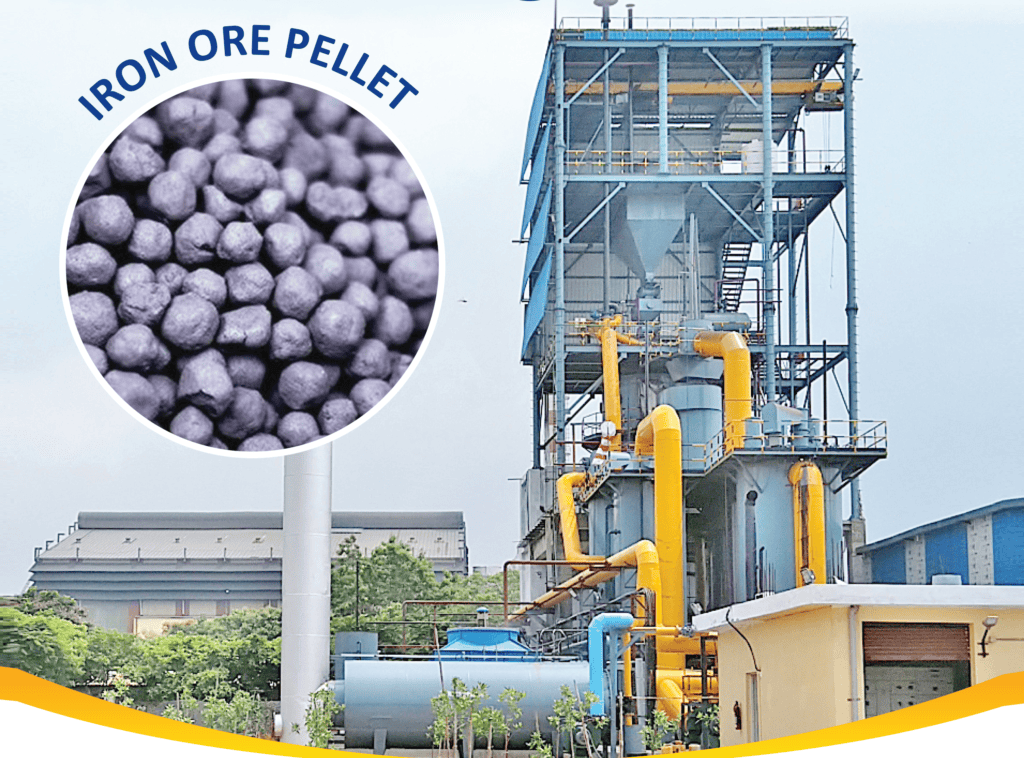
Steel Industry – Iron ore pelletisation Kilns with all three designs – Straight grate, Rotary Kiln and Circular Kiln need fuel to fire pellets at 1250 °C successfully replaced by Coal Gas

Steel Industry – Tunnel Furnaces for Slab Rolling mills need fuel for heating thin slabs to 1200°C successfully replaced propane by Coal Gas

Steel Industry – Reheating Furnaces for Rolling mills to producing long or flat steel need fuel for heating steel successfully using Coal Gas

Steel Industry – Stainless steel hot and cold rolling mill furnaces need a steady, controllable flame at 1050 °C successfully replaced LNG by Coal Gas

Refractory Industry – Tunnel kilns needed fuel to bake the refractory bricks successfully used Coal Gas

Ceramics Industry – Tiles and Tableware sector including Wall and floor tiles, bone China, sanitaryware and insulators kilns demand clean fuel and uniform firing successfully replaced LNG by Coal Gas

Glass Industry – horse shoe regenerative kilns need temperatures up to 1700 °C successfully operated with Coal Gas.

Alumina Industry – Calciners rotary kilns or flash calciners operating at 1100°C operating on Coal Gas.

Dev Energy has in last 24 years completed projects successfully in above industries providing end user with exceptional economic advantage.

FIXED BED TECHNOLOGY – PROVEN & PRACTICAL

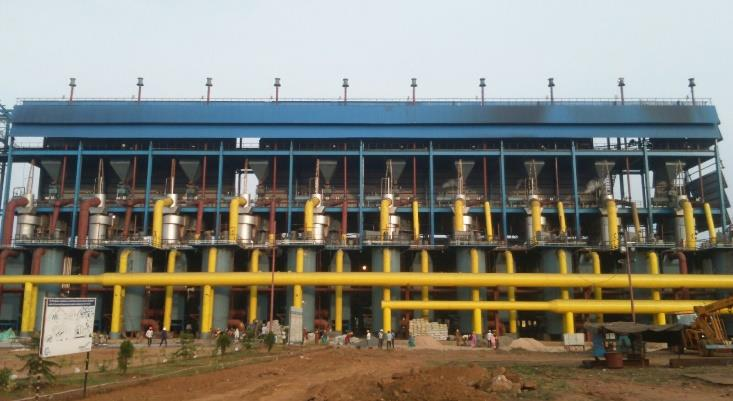
Dev Energy has developed and matured most energy Efficient and environmentally suitable solution in form of Double Stage Clean and Cold Gas technology.

KEY FEATURES:

Upstage gas -> Volatile Matter Extraction

At low temperature with CV > 1750 kcal / Nm3

Downstage gas -> Carbonised gas generation

At high temperature with CV > 1250 kcal / Nm3

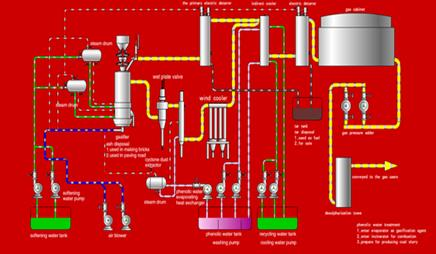
The advantage of Double stage gasification is that the down stage gas being tar free can be treated in the

cyclone to remove the dust particles, then cooled through Heat exchanger and an Air cooler. The upstage gas being at cooler goes directly into ESP – Detarrer to remove tar. These Upstage and downstage gases are then mixed in indirect cooler and cooled to 45 °C. Then the final gas pass through ESP – Deoiler. The coal gas is DE-sulphurised and pressurised to the desired pressure and then transmitted to end user.

The Tar generated is clean and moisture free and can be used as fuel. The phenolic water generated is all cleaned and reused in the system itself crating a ZERO LIQUID DISCHARGE system.

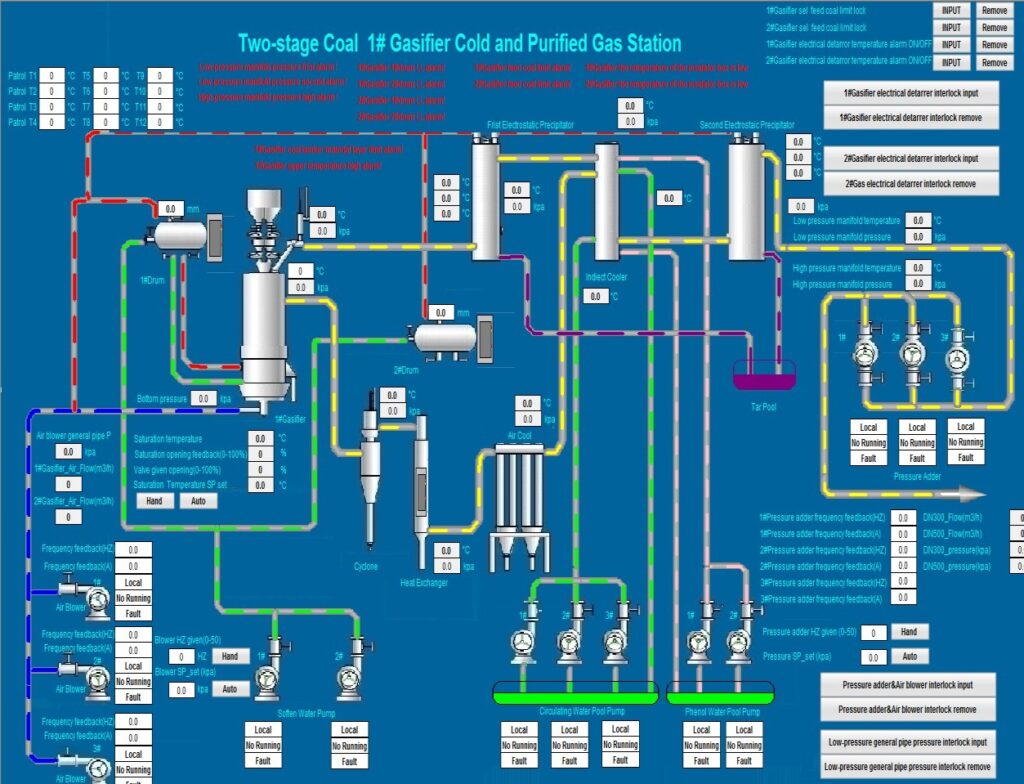
The E & A uses the latest PLC – DCS based Scada systems to Integrate, Automate the Controls making the system reliable & Safe for operations.

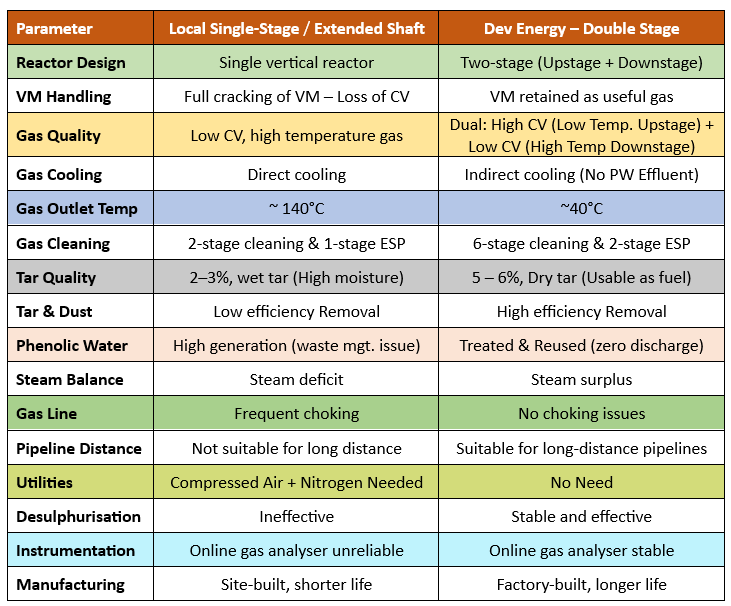
COMPARISON: DEV ENERGY VS CONVENTIONAL

CFB TECHNOLOGY – HOW IT WORKS?

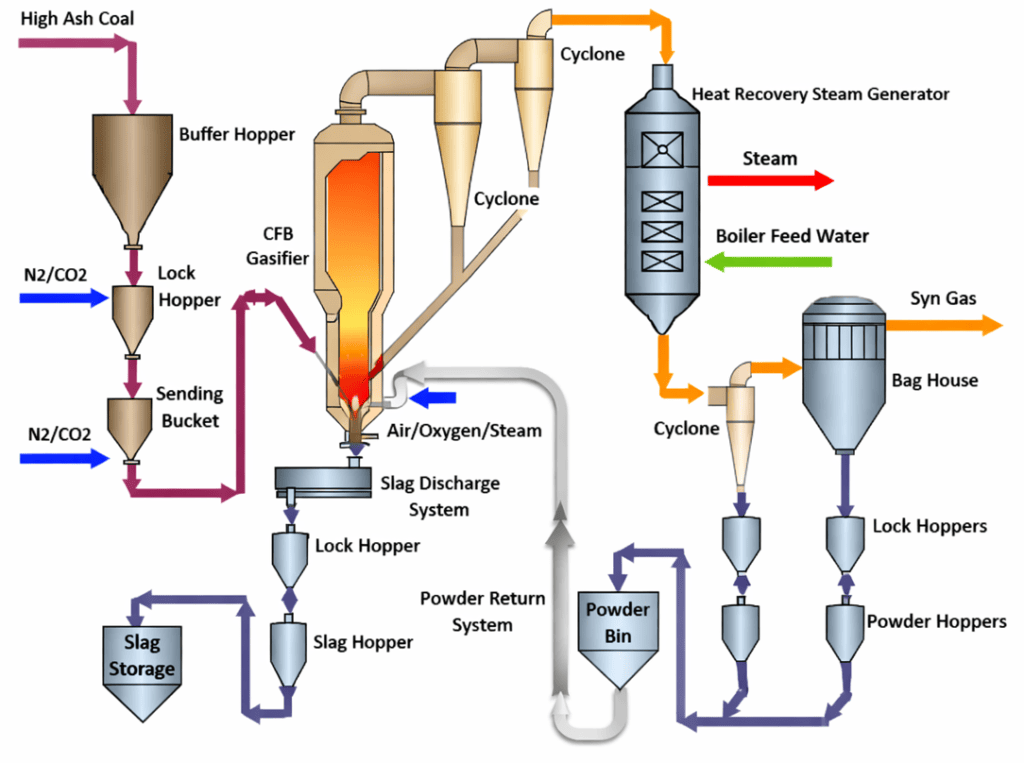
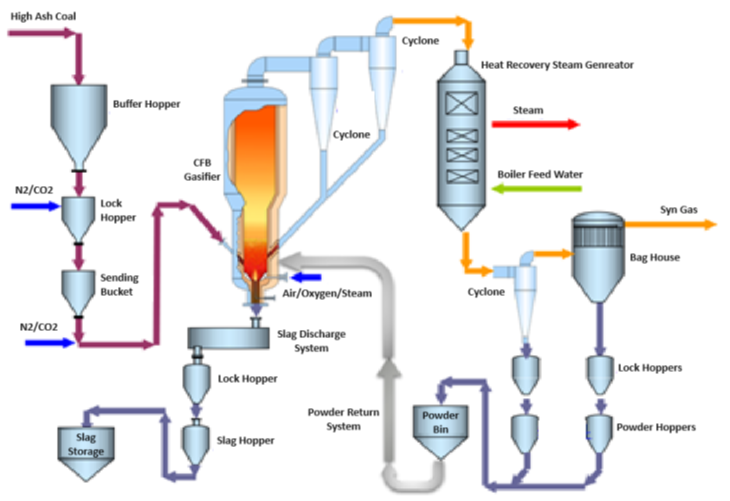
Circulating Fluidized Bed (CFB) technology is a coal gasification process where solid fuels are converted into a SYN gas at high temperature in presence of oxygen and steam. Coal is processed through grinding, sorting, and/or drying to bring the feedstock < 10 mm particulate size.

Crushed coal is pneumatically conveyed into a pressurized lock hopper, which feeds it into the CFB gasifier. The coal combines with oxygen and steam as gasification in the fluidized bed at temperature of 1000 o C to provide high carbon conversion and non-slagging of ash. Ash is removed by gravity from the gasifier and is discharged into a system for depressurization and disposal. The gasifier maintains a low level of carbon in the bottom ash discharge stream.

Fines carried over from the fluidized bed are separated from the syngas prior to heat recovery and syngas cleanup in the cyclone and bag filter. The product syngas is essentially free of tars and oils due to the temperature and residence time of the gases in the fluidized bed, simplifying downstream heat recovery and gas cleaning operations.

CFB gasification design using waste heat recovery process, which can recover the heat from syngas to produce high temperature and high-pressure steam along with oxygen preheating resulting in overall optimum thermal efficiency.

The fluidized bed design results in long residence times of the reacting particles and the fines have a two-stage recycle back process with all returning to gasifier. This helps achieve the overall carbon conversions > 98% which is among the highest in the world.

CFB TECHNOLOGY FEATURES

ECONOMICS – SAVINGS BENEFITS

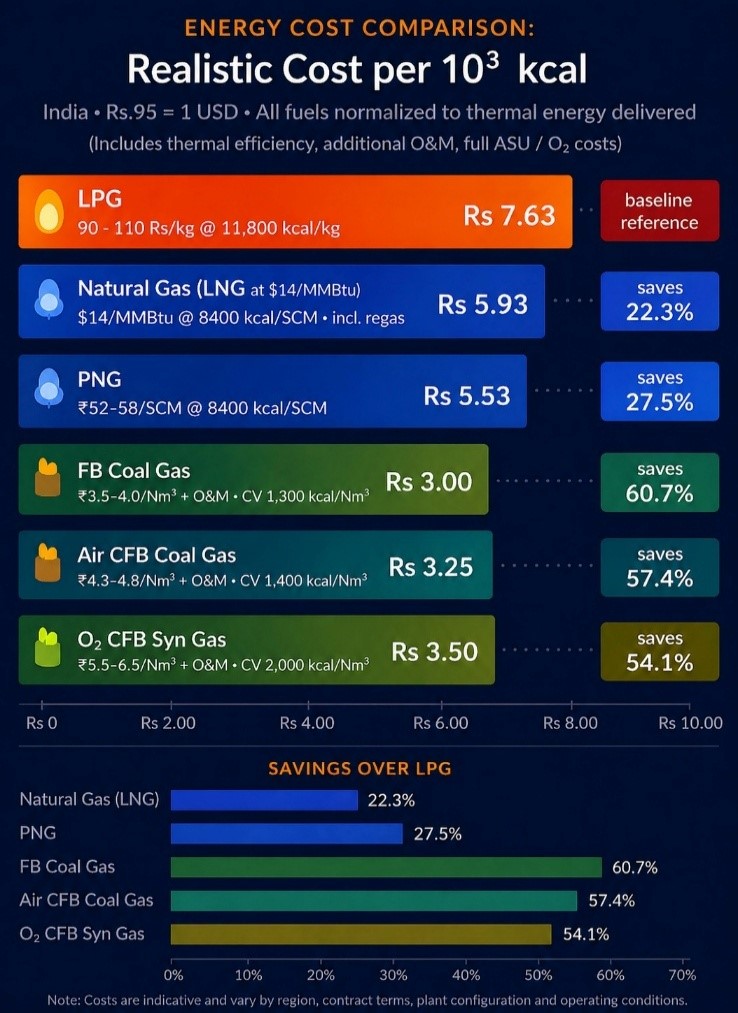
The key to adaption of COAL GASIFICATION is the acceptance of the Economic Benefits of using Indian Coal vs expensive fuels. We have developed a comparative of cost of 10,000 Kcal energy from all difference fuels as per current prices. From the table, it is clear that the real benefits are saving of more than 50% of fuel expenses.

A futuristic idea is also an integration of the coal gasification system combining Fixed Bed (FB) and Air-blown Circulating Fluidized Bed (CFB) technologies provides an efficient solution for industrial fuel generation. Lump coal is processed in the fixed bed gasifier to produce relatively clean, moderate-calorific-value syngas, while coal sizzing < 15 mm as rejects are utilized in the CFB gasifier, ensuring complete fuel utilization. Both units generate FUEL GAS primarily composed of CO, H₂, and CH₄, which is routed to a central gas network for uniform distribution across plant applications.

The use of air-blown gasification eliminates the need for an oxygen plant, significantly reducing capital and operating costs. This hybrid configuration enhances fuel flexibility, improves overall efficiency, and optimizes resource utilization. The produced FUEL GAS can effectively replace conventional fuels such as LPG, PNG, and Furnace oil in various industrial heating processes. Typical applications include steel reheating, stainless steel production, ceramics manufacturing, alumina calcination, and cement kilns.

CONCLUSION

Crude Oil derivatives and Natural gas are increasingly becoming expensive fuel options for the industry and with prices often fluctuating due to geopolitical factors and supply chain remaining uncertain, making them as the backbone of the industry is now making the complete plant dependent on unreliable energy sources.

In contrast, COAL GASIFICATION offers a stable and cost-effective alternative by converting abundant Indian coal reserves into cleaner gaseous fuel, ensuring consistent supply and economic viability.

Backed by strong expertise and operational experience, Dev Energy delivers dependable coal gasification solutions that are both affordable and efficient, positioning it as a reliable partner for sustainable energy needs. These are not claims but experience form > 250 proven commercial scale plants operating providing a ready solution in from of basic engineering, detailed engineering, and EPC solutions.

Future-Ready Low-Carbon Green Iron & Steel: CFB Coal Gasification Pathway

By UncategorizedNo Comments

Why Now?

The world is in need of processes and technologies that reduce the global carbon footprint. Every two decades steel mills need upgradation and reinvestments and in this current cycle of refurbishment, there is a chance to use low-carbon technologies that can upgrade two-thirds of the current production capacity to Green Steel before 2030. This presents a critical window of opportunity to retrofit the existing blast furnaces (BF-BOF) and Natural Gas Reforming based Direct Reduction of Iron (DRI- EAF) vertical shaft Kins with low-carbon technologies. One of the proven and available technologies is Circulating Fluidised Bed (CFB) Coal gasification with ready to use Carbon capture, Utilisation and Storage (CCUS).

What is Green Steel?

Global recognized organizations like WSA and IEA have not yet clearly defined the term green steel, instead, they define low- carbon steel in their climate change policy paper as “Steel that is manufactured using technologies and practices that enables the emission of significantly lower CO2 than conventional
production”

Currently as per global statistics, almost 71% of steel is currently being made using the BF-BOF process, with 29% produced by the EAF method. The conventional BF-BOF & Horizontal DRI Kiln routes are dependent on High-Carbon intensity raw material like coal and coke.
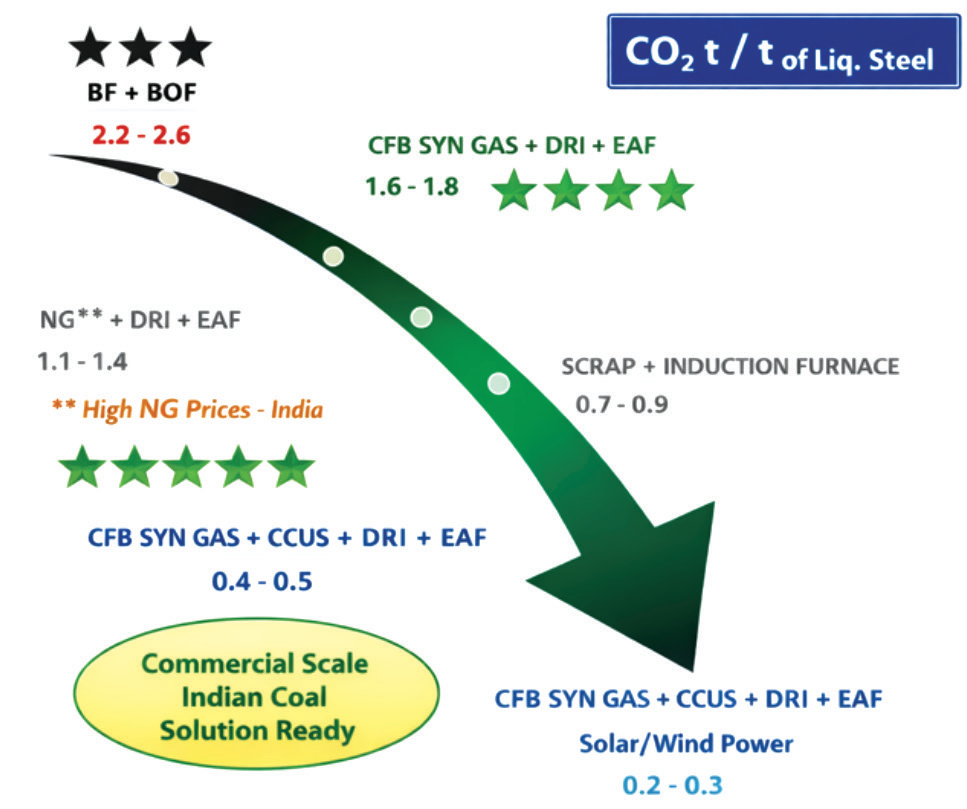
As you can see below, the Carbon Dioxide emissions from the conventional route are in the range of 2.2 – 2.6 t of CO2 /ton of steel.

Low-Carbon intensity green steel is central to achieving global decarbonization targets, as the fast-growing steel industry accounts for about 7–9% of global CO2 emissions. Now, Carbon Boarder Adjustment mechanism (CBAM) as is getting implemented globally and for steelmakers the higher CO2 intensity means higher costs directly impacting competitiveness and margins. The newer technologies can bring down the carbon dioxide emission to 0.2 – 0.3 t of CO / ton of steel.

The simplest technology that can reach the stated target is to use vertical DRI kiln where the reduction is by Synthetic Gas or SYN GAS from coal Gasification.

Basics of Low-Carbon Steel Making

As you can see from the diagram, the reduction has to happen with removal of oxygen molecules by use of carbon or hydrogen and heat has to come from either chemical of electrical energy. The key to resolving the carbon emission questions is to shift to processes that emit least carbon dioxide.

Coal Gasification generating SYN gas is the best bet for the future of steel making.

How SYN Gas is Path Forward?

Coal Gasification makes SYNGAS which is a mixture of hydrogen (H2), carbon monoxide (CO), and methane (CH4) (75 – 80% mol) with some carbon dioxide (CO2) made from coal with use of oxygen and steam firring. The basic gasification reactions are

1. C + H O → CO + H (Hydrogen)

2. C + O → CO (Carbon Monoxide)

3. C + 2H → CH (Methane)

The SYN gas generated through Coal Gasification is then cleaned and cooled through multiple stages to achieve the final state where it can be used as reduction gas for the vertical DRI kiln. Dev Energy has partnered to provide the proved technology of Circulating Fluidised Bed (CFB) gasification for the production of the SYN gas and transformation of the same to the desired specifications of stell industry.

CFB Technology – How it Works?

Circulating Fluidized Bed (CFB) technology is a coal gasification process where solid fuels are converted into a SYN gas at high temperature in presence of oxygen and steam. Coal is processed through grinding, sorting, and/or drying to bring the feedstock < 10 mm particulate size.

Crushed coal is pneumatically conveyed into a pressurized lock hopper, which feeds it into the CFB gasifier. The coal combines with oxygen and steam as gasification in the fluidized bed at temperature of 1000 C to provide high carbon conversion and
o
Coal Gasification generating SYN gas is the best bet for the future of steel making.
How SYN Gas is Path Forward?
Coal Gasification makes SYNGAS which is a mixture of hydrogen (H2), carbon monoxide (CO), and methane (CH4) (75 – 80% mol) with some carbon dioxide (CO2) made from coal with use of oxygen and steam firring. The basic gasification reactions are
1. C + H O → CO + H (Hydrogen)
non-slagging of ash. Ash is removed by gravity from the gasifier and is discharged into a system for depressurization and disposal. The gasifier maintains a low level of carbon in the bottom ash discharge stream.

Fines carried over from the fluidized bed are separated from the syngas prior to heat recovery and syngas cleanup in the cyclone and bag filter. The product syngas is essentially free of tars and oils due to the temperature and residence time of the gases in the fluidized bed, simplifying downstream heat recovery and gas cleaning operations.

Fines carried over from the fluidized bed are separated from the syngas prior to heat recovery and syngas cleanup in the cyclone and bag filter. The product syngas is essentially free of tars and oils due to the temperature and residence time of the gases in the fluidized bed, simplifying downstream heat recovery and gas cleaning operations.

CFB Technology Features & Advantages

CFB gasification design using waste heat recovery process, which can recover the heat from syngas to produce high temperature and high-pressure steam along with oxygen preheating resulting in overall optimum thermal efficiency.

CFB is more fuel-flexible with utilization of low-rank and other high-ash coals. It offers higher efficiency than competing gasification technologies. As fines carried over from the fluidized bed are separated from the syngas prior to heat recovery and syngas cleanup.

There are proven commercial scale plants operating in China and ready solution is available from basic engineering, detailed engineering, and EPC solutions

Why CFB?

Integration CFB – Vertical Kiln DRI

Dev Energy has completed the detailed study and can offer solution as required by all global vertical shaft DRI technology Licensors making it wide adaptability for overall technical and commercial optimisation to make Green Steel.

Case Study: 0.5 MTPA DRI – Vertical Shaft DRI Kiln
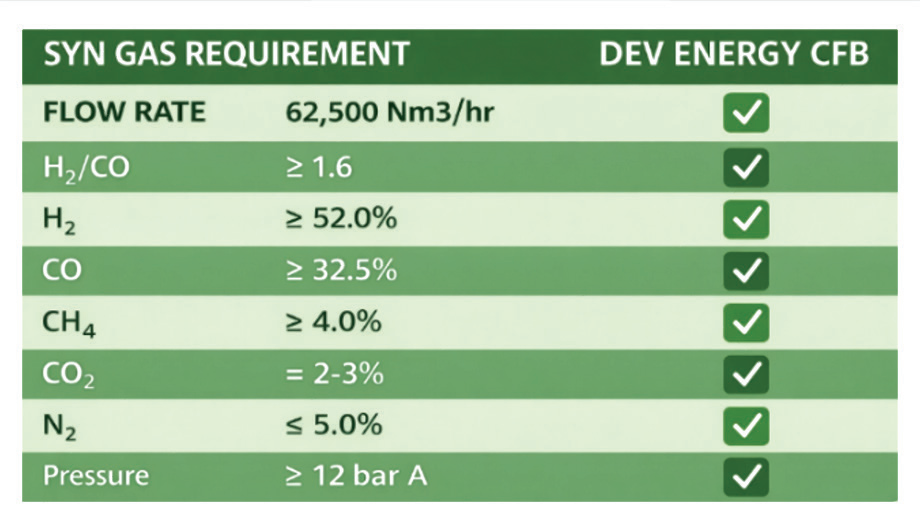
The solution is to tailor the SYN gas composition to the requirements of the DRI technology Licensors. Below are the details of requirement for the stated case study:

The SYN gas produced from the CFB gasification is transformed through the Water Shift reactor to balance the H2/CO ratio. The technology has the complete flexibility of H2/CO ratio such as 1.1, 1.6 or even future -proof 100% Blue H2.
The water shift reaction generates carbon dioxide and the amine wash technological process is used to remove the CO2 from the SYN gas. The same process also eliminates the sulphur present in form of H2S in the gas making is as per the requirement stated above.

CFB gasification adopts oxygen-enriched gasification, and the N content in syngas can be effectively controlled below 5% or lower. CFB gasification pressure is high avoiding any downstream compression requirement, and the CH content in the syngas can
4
be up to Controlled ideal for DRI steel-making feedstock.
The final simulated performance of the DRI kiln is enumerated below.

CO is threat and not COAL

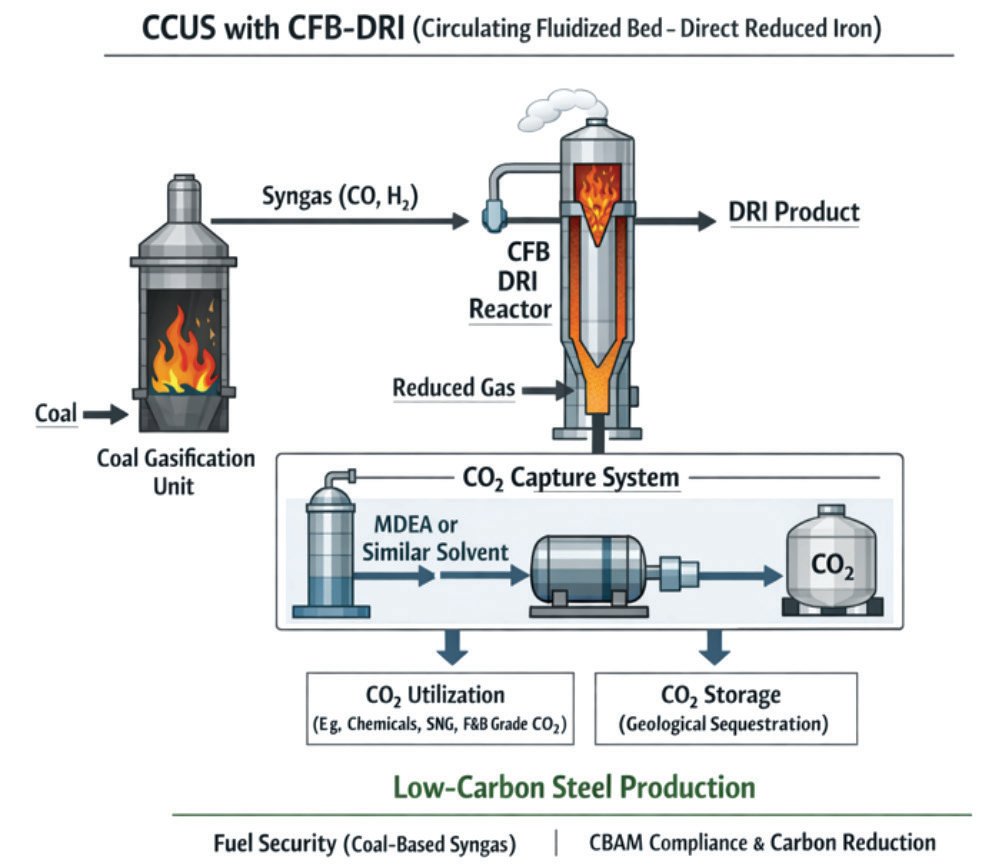
To drastically lower process CO2 emissions, CCUS with CFB- DRI (Circulating Fluidized Bed – Direct Reduced Iron) combines carbon capture systems with CFB coal gasification. In order to produce low-carbon steel, CO is isolated from the reducing gas loop using MDEA. The same is either used to make chemicals or used as F&B grade CO2 or permanently stored. This arrangement aligns DRI operations with CBAM and future carbon pricing regimes while improving the plant economics.

National Policy Support

India being 2nd largest producer of crude steel, Government of India has started offing various mechanisms of Viability Gap funding (VGF) for Coal Gasification and for Carbon Capture Utilization and Storage (CCUS). Ministry of Coal (MoC) and Ministry of Steel (MoS) have both emphasized on Low-Carbon intensity green steel making through coal gasification.

Dev Energy – Rediness:

 CFB coal gasification, optimally integrated into a vertical kiln-based downstream steel plant, will deliver green steel as shown below:

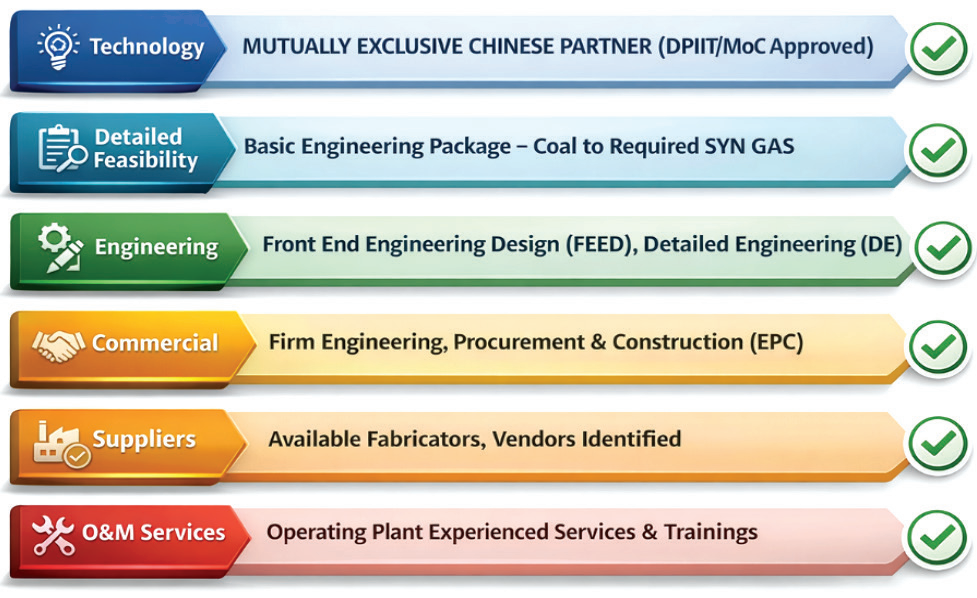
DEV ENERGY with its successful Turnkey EPC solution is ready with the complete design and implementation plan for the proven solution with exclusive partnerships already in place. We already have delivered for more than 23 years and are committed to Sustainable Low-Carbon intensity Green Steel Solutions. Dev Energy offering is through experienced & qualified team for Coal gasification and all other related infrastructure for the projects for DRI Vertical Kilns for Green Steel with committed after sales service and handholding till operational success.

Smarter Scrap Processing to enhance Steel Melting Furnace Efficiency: Case Study for West Africa

By UncategorizedNo Comments

Introduction

Steel Scrap plays a pivotal role in today’s steel making and has become the most critical raw materials in modern steel melt shops. In the world moving towards green future, there is an increasing emphasis the recycling of steel. The usage of steel scrap helps in reduction of the net carbon footprint of steel produced. The strategic use of scrap has transformed steel plants from being purely ore-based operations to circular, resource-efficient facilities. Whether it is in an Electric Arc Furnace (EAF) or in an Induction Furnace (IF) the scrap quality directly influences the productivity, metallurgy and environmental performance of the steel melt shop.

In Africa, for decades there existed a unique situation where the steel scrap was available in abundance due to the availability of war scrap and absence of steel making plants. The scrap was not used or processed and therefore available at cheap prices. The abundance did not immediately transform the industry into large scale scrap recycling-based steel melting production because of lack of any local government support or investors ready to take the opportunity. In recent years, the scenario changed completely and almost all countries have banned the export of steel scrap. All local governments have pushed investors to setup scrap recycling-based steel plants.

Initially, the abundant scrap availability and low prices resulted in steel melting practices where neither technology nor cost was considered, and only goal was to produce hot metal anyhow. Since 2022, due to the surge in steel demand and uptick in the prices of steel the industry has taken a second phase of investments and the companies are upgrading and upscaling their facilities. The maturing of markets has resulted in the newer plants shifting their focus on cost optimization, energy efficiency, and sustainability. The essential step in this exercise is to work on management of the Steel scrap with addition of the Scrap processing facilities.

Challenges of Scrap Processing in Africa

The available steel scrap in Africa is in very bad shape and form. The shapes, sizes and quality are varied and this deteriorated scrap quality has necessitated the preparation of scrap into usable scrap. This is done through scrap processing machines for achieving better efficiencies in steel melting furnaces.

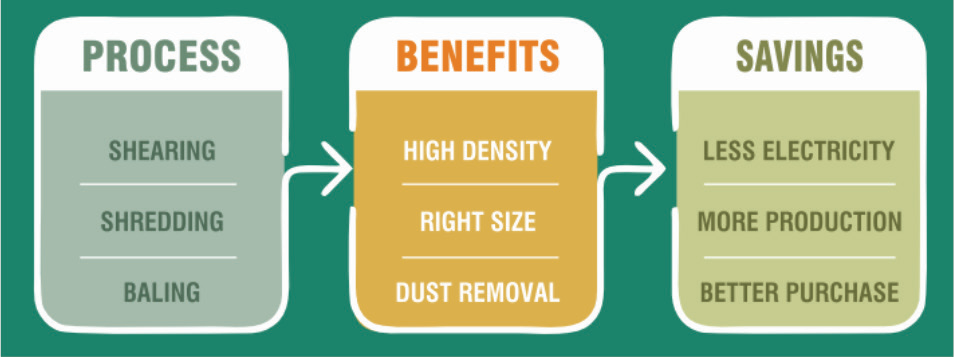
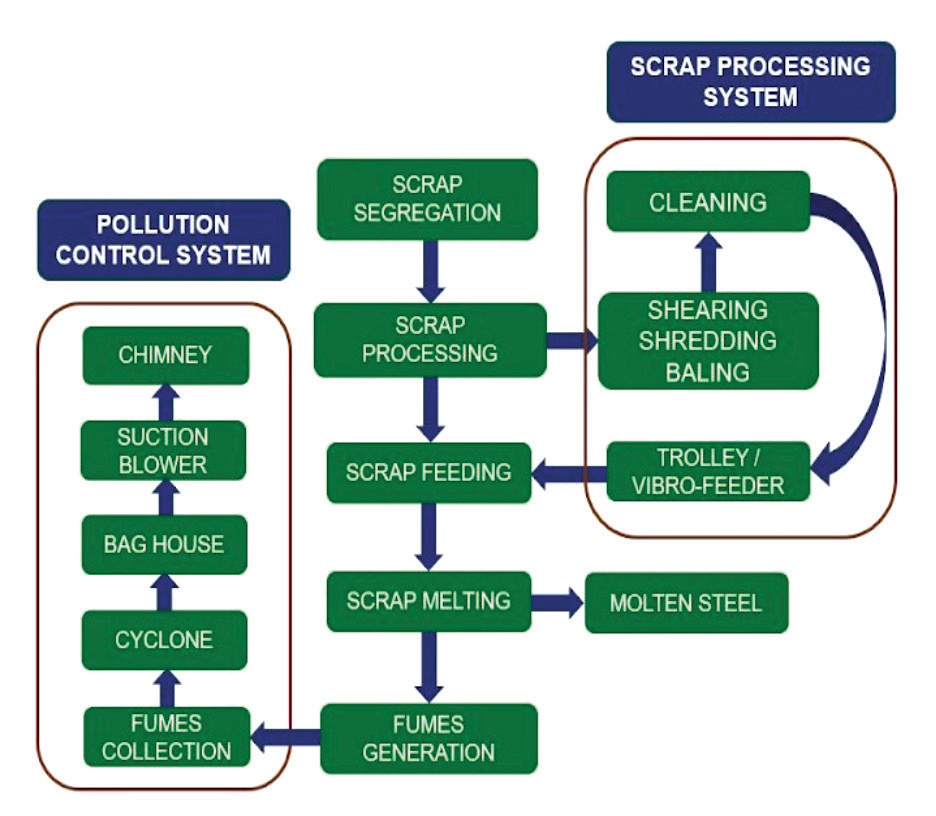
The concept of Scrap processing is to undertake the following processes to achieve the desired goals.

Sort -> Process -> Clean

The goal of the processing is to get the final scrap which is

  • Sorted
  • Sized
  • Dense
  • Clean – dust free
  • Segregated

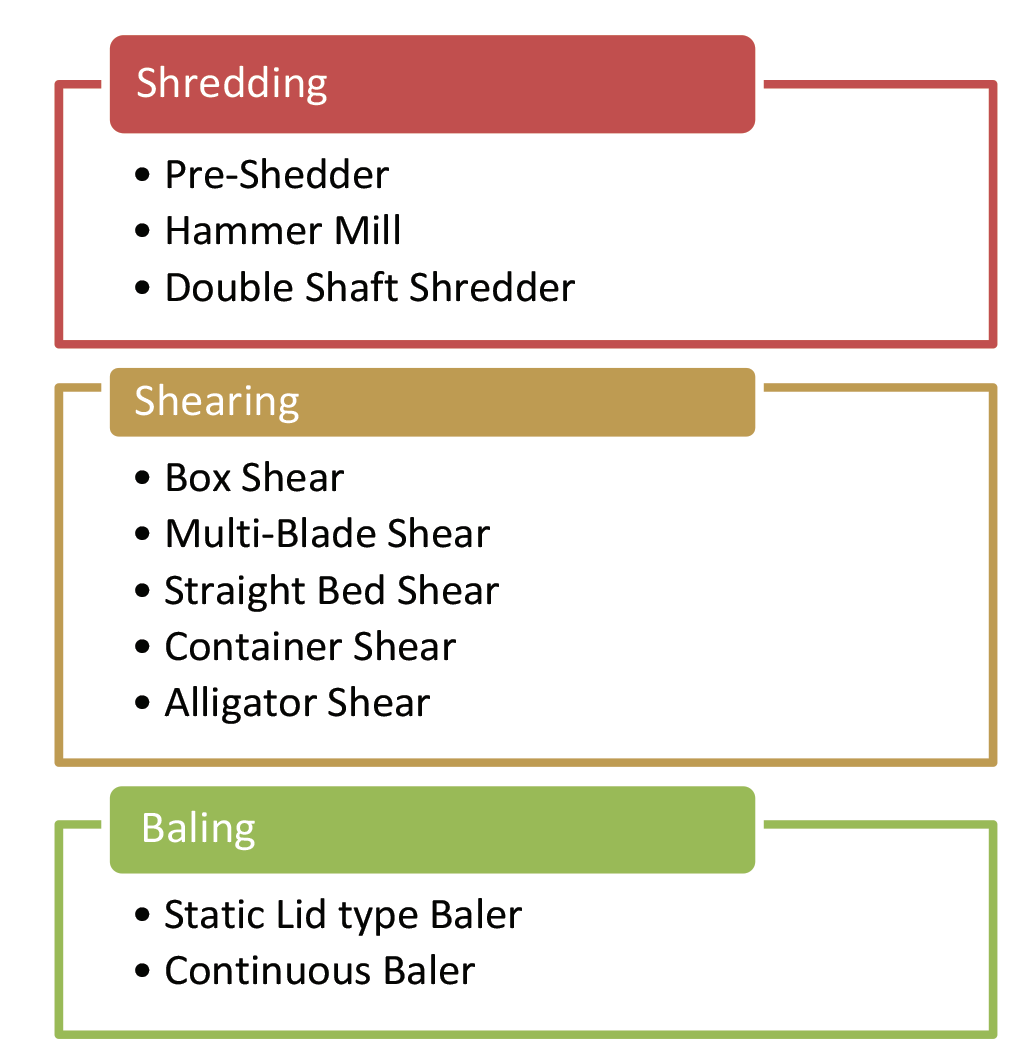
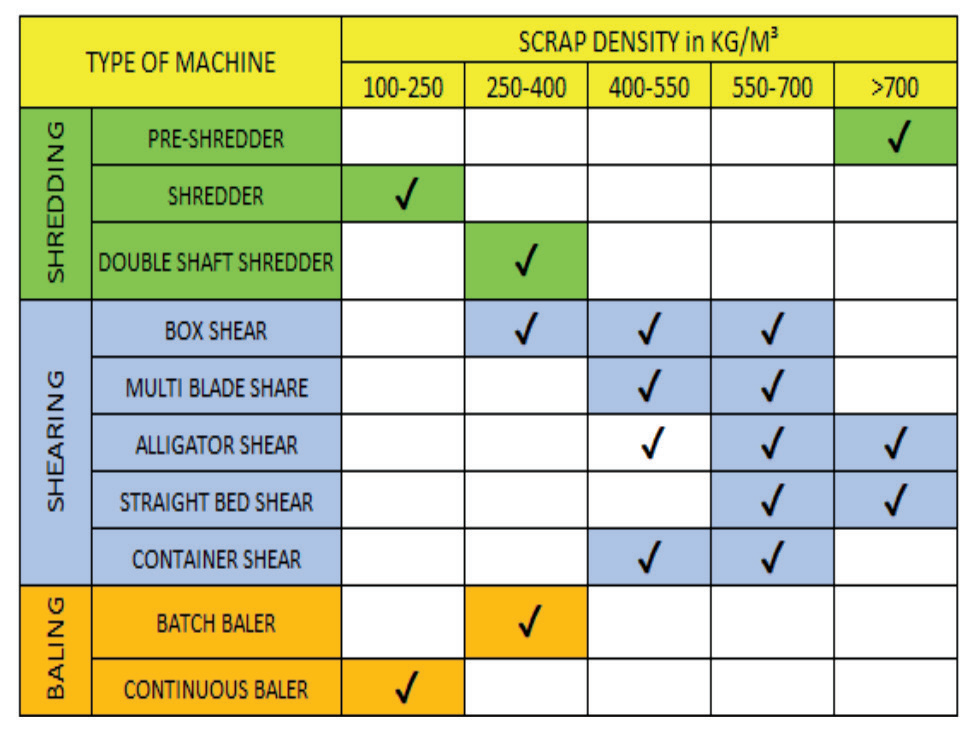
The processing of scrap can be achieved through three basic process methodologies which are shredding, shearing and baling. The suitable solution for any plant is to process the scrap in the proper parameters using machinery matching the type of scrap. The process identification depends on the type of Raw Steel Scrap, its density, its size, its cleanliness level, the size of the furnace, power density of the furnace etc. There are various types and size of machines available to process scrap from 01 to 100 t/hr.

Advantages of Scrap Processing

The processed scrap is sized, denser and cleaner for faster charging in the furnace. This processed scrap consumes less power per ton of steel produced, results in high productivity for the furnace. Power is the major cost in making steel. The scrap shape, density and size are the variables that determine the time required for melting. The input scrap that is improper results in longer time for melting and higher power consumption. Dev Energy has been actively working on reduction of power with its dynamics and interrelation to scrap processing.

Unprocessed Scrap Processed Scrap
Size Irregular Uniform
Density Low to medium High
Melting Slow & Uneven Fast & consistent
Risk Bridging none
Power Used ~ 750 kWh/ton ~ 650 kWh/ton
Yield 90 – 92% 94 – 96%
Slag Volume High Low

Dev Energy has developed expertise to provide innovative turnkey solution for efficient scrap segregation, processing and feeding in the furnace. This feeding system also has to be integrated with the pollution or Flue control system generated during melting. Our scrap solutions can be tailored to plant needs and help melting shop manage any type of input scrap; while increasing scrap value and employee safety through efficient of scrap handling. Our systems not only make scrap easier to manage, then low-cost operations reduce waste thus lowering the total cost and providing immense value to the company.

Case Study on 1000 tons / day Scrap Processing Solution in West Africa

In an era where operational efficiency defines competitiveness, a 1000 TPD induction furnace-based steel plant offers a compelling example of how smart scrap preparation can unlock measurable performance gains. Struggling with inconsistent charge material, prolonged heat cycles, and rising energy costs, the West Africa steel plant took a decisive step by inviting Dev Energy to propose and then supply the complete integrated Steel Scrap processing system.

Prior to transformation, the plant had negligible scrap processing and the unprocessed scrap handling and charging practices posed significant operational challenges that directly impacted furnace performance and overall cost efficiency. The resulting low furnace productivity driven by inconsistent scrap size and density resulted in unstable melting behaviour and prolonged heat cycles. This inefficiency was further compounded by higher power consumption as the furnace was required to compensate for dirty poor scrap and energy absorption by huge amount of slag.

In addition to above, the plant experienced notable metallic yield deterioration due to excessive oxidation and higher slag generation. Increased slag volumes also accelerated refractory wear, leading to frequent repairs and shortened lining life. Safety risks were also elevated, particularly during manual scrap handling and charging operations, while inconsistent scrap chemistry made it difficult to achieve stable steel compositions, increasing the need for corrective additions.

These technical shortcomings translated into higher maintenance requirements, unplanned downtime, and increased operating interruptions, all of which adversely affected production reliability. The heat times were extended to approximately 150 minutes per cycle, and despite the installed furnace capacity of more than 1000 tpd, the daily production remained capped at around 650 tpd.

As the first step to the designing the integrated solution, Dev Energy studied Scrap-Mix composition in terms of type of scrap, its size, density and dust levels. The plant’s input scrap was noted to be highly variable scrap mix, which created significant challenges in suggesting a consistent solution.

The scrap charge was composed of ~ 5 % HMS 1 and 20 % HMS 2, proving a limited availability of heavy, dense scrap. A substantial portion of the mix consisted of light scrap ~ 30 %. The remaining 45% comprised locally sourced unsegregated mixed scrap characterized by wide variations in size, density, quality, contamination levels and chemistry.

Solution

A detailed assessment revealed several critical pain points in this scrap mix that the plant was procuring. The average bulk density of the scrap remained low, in the range of 0.3 – 0.4 T/m. Dev Energy team mapped the scrap to the machines that can process the scrap without segregation.

BOX SHEAR 1250 TONS – FOR – HMS 1 & HMS 2

LARGE BALER 400 TON – FOR – LIGHT SCRAP

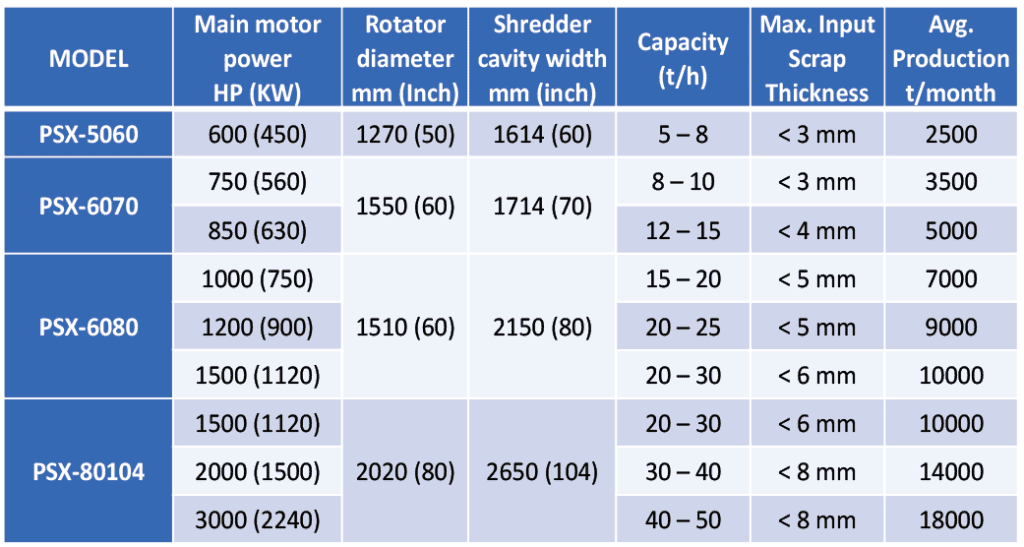
SHREDDER 1500 HP – FOR – LOCAL MIX SCRAP

Box Shear – 1250 Tons

It was identified that the input scrap HMS 1 & 2 is sourced and transported into plant in trucks which could be unloaded at one location. We proposed a Box Shear machine and calculated machine capacity of ~ 400 tpd output.

The machine is ideal for all variety of Scraps. It has the capacity for three sides of compression and additional gate side pressing & clamping. Then the desired density of scrap increased by 5 times. Finally, the Shearing blade shears the scrap into pieces of length < 350 mm with force of 1250 tons.

Shear force                         : 1250 tons

Capacity                               : 25 – 30 tph

Operation Expense         : ≤ INR 200 / t

Output Density : 1.0 – 1.2 T/m³

The machine installed is attached with a Dust Separation system integrated with magnetic separator and screening which will segregate the dust, mud, rubber, plastics and non-ferrous contaminants form the processed scrap.

Large Baler – 400 Ton

It was decided that the super light Input scrap with plate of thickness < 0.3 mm like CR punching and turning needs Baling as the same is not suitable for shearing and shredding. The estimated quantity was ~ 200 tpd and we proposed Large 3 side compression Balers.

The proposed balers will transform the light scrap into dense, consistent bales. The size of the box was taken as large with size as 3.0 m x 3.5 m and the final force of compression was 400 tons. These bales have to feed into the induction furnace so the dimensions of bales were decided as 600 mm x 600 mm x 600 mm.

Main force                          : 400 tons

Bale Weight                       : 700 – 800 kg

Bale Size                              : 600 x 600 x 600 mm      

Bale Density                      : 1.8–2.2 T/m³

Operation Expanse         : ≤ INR 125 / t

The machine installed has three sides compression, automatic PLC control, Cycle time less than 120 sec and has fully hydraulic driven operation. The main operational flexibility is for exiting the bale through Centre / Side FLIP out

Scrap Shredder- 1500 Hp

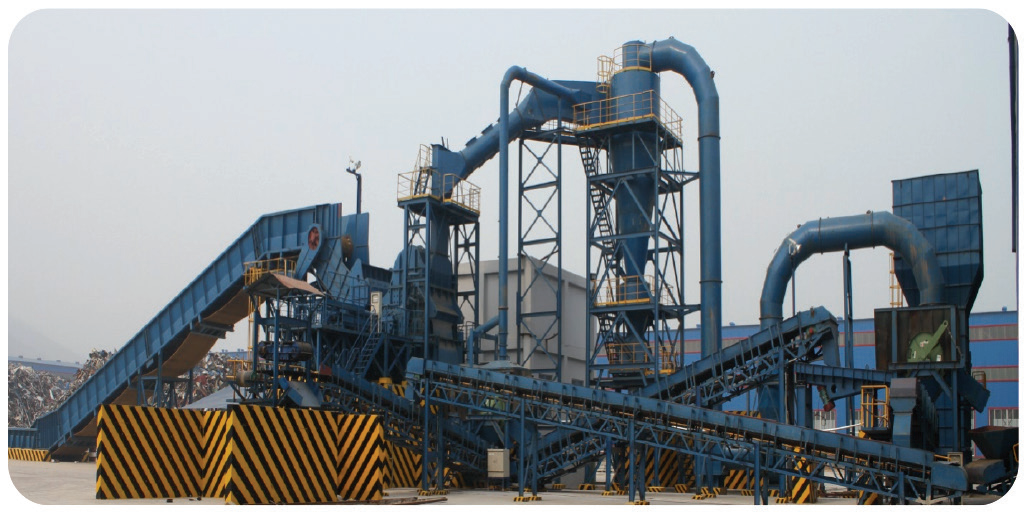
It was identified that the major input is the local mixed scrap which is sourced from multiple places and cannot be segregated. The shredder with Hammer Mill with capacity of ~ 500 tpd output was proposed.

The complete shredding line was installed with multiple stages of scrap cleaning and the machine brought a quantum leap in cleanliness and uniformity.

Output Density                 :  ~ 1.6 – 2.0 ton/m²

Output Size                        : < 90 mm

Metal Recovery                                : ≥ 99%

Operation Expense         : ~ INR 650 / t

The system was installed with the following optional add-ons

Sound Proof Enclosure

2nd Magnetic Separator

Blue Smoke Inhibitor

Video monitoring

Manual Shorting Station

Bag House De-Dusting system

Z Box Air-cleaning system

Non-Ferrous Segregation

The final output dense clean and was free of dirt & impurities.

Operational Impact

The operational impact was immediate and quantifiable. Scrap processing equipment provided the melting furnaces with uniform scrap density and cleaner scrap creating a predictable and controllable charge composition. The heat times were reduced by nearly 20 % allowing faster induction furnace turnaround and increase in the throughput by 20%. The power consumption dropped sharply delivering savings of up to 40 kWh per ton of liquid steel. The metallic recovery was observed to be much better with 1.0 – 1.5% increase in yield. The steel melt shop was cleaned and safer as fumes were less and the incidence of bridging almost disappeared. 

Financial Impact

The financial outcomes of the project were nothing short of remarkable. The project has stood out for its strong business case as the entire investment achieved payback in less than six months, reinforcing the strategic value of upstream scrap processing.

A modest ~ 1% improvement in metallic yield, at an approximate scrap cost of ~ ₹32,000 per to translated into ~ ₹ 8.0 crore per annum savings. The power consumption gains delivered even greater value with a reduction of ~ 30 kWh per ton at a power cost of ~ ₹7 per kWh resulted in nearly ₹45.0 crore per annum savings. The additional benefits arising from the reduction of the maintenance time, lower refractory consumption in furnaces and lesser accidents contributed a further ~ ₹5.0 crore annually.

Collectively, these improvements generated total annual savings in the range of ~ ₹ 50 – 60 crores against a relatively modest capital investment of approximately ₹40 crore. The result was an exceptional payback period less than 8 months which is a level of return rarely seen in steel plant modernization initiatives, firmly establishing integrated scrap processing as a high-impact, high-confidence investment.

This case underscores a broader industry lesson that the scrap is no longer just a raw material but a lever of performance which when used intelligently becomes a decisive factor in energy efficiency, yield optimization, and sustainable steelmaking. The proper selection and use of Scrap processing Machines can transform the economic viability and operational excellence of the scrap-based steel plant.

Dev Energy reaffirms its commitment to provide innovative solutions for the specific engineering-based solution designed to the specific need of the steel plants. The solutions are turnkey, reliable and cost effective making the user trust the outcome.

Walking Beam Slab Reheating Furnace with 100 % Clean Coal Gasification: Innovation in Flat Steel Rolling

By UncategorizedNo Comments

Introduction

Steel Industry in India is growing and evolving faster than ever, driven by need for lower costs, stricter emission norms, and the constant demand for better-quality. At the centre of every steel plant is the Reheating Furnace which quietly determines the energy consumption of the plant and the quality of the final product. In order to be able to meet all these demands, steel makers need to adapt innovative solution. This is where the combination of Walking Beam Reheating Furnaces and modern Coal Gasification together offer a practical, reliable and cleaner alternative to traditional fuels, while ensuring consistent and high-quality reheating.

Role of Reheating Furnaces

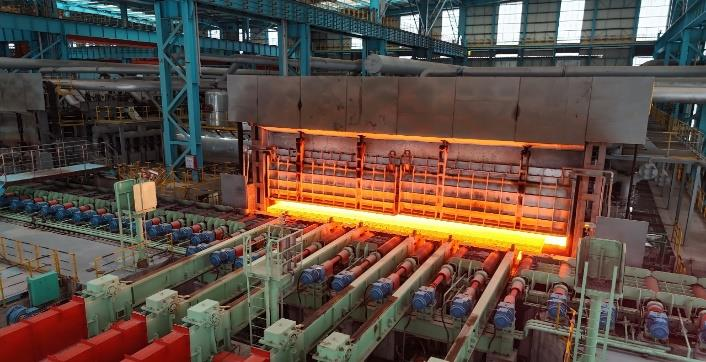
Reheating furnaces play a crucial role in the steel industry by heating the semi-finished steel products such as billets, blooms, and slabs to the required rolling or forging temperature. Reheating furnaces ensure that semi-finished raw steel materials reach the ideal temperature for deformation during rolling or forging. We must note that before these products can be rolled into final shapes, they must be reheated to precise temperatures — typically between 1,100°C and 1,250°C. This proper reheating directly affects the metallurgical properties, surface quality, and mechanical strength of the final steel rolled or forged product.

Hence, furnace design and performance have a direct impact on Quality, Productivity, Energy consumption, production cost and overall plant efficiency.

There are many types of reheating furnaces based on the configuration. The some of the important variables that define the furnace are

Variable / Parameter Types / Options
Fuel PCI / NG / LPG / Coal Gas / BF - Coke Oven Gas / Furnace Oil
RM Movement Pusher / Walking Hearth / Walking beam / Chamber / Bogie
RM In / Out Side In - out / Pusher - Ejector / Drop
Shape Floor / Top & Bottom / Neck
Burner configuration Side & front / Side Top & Bottom / Roof
Heat Recovery Recuperative / Regenerative

Why Walking Beam

In the competitive world of steel manufacturing, efficiency, product quality, and operational reliability are the cornerstones of success. The traditional reheating furnaces suffer from problems of uneven heating of the steel, high fuel consumption, and increased oxidation losses. The Walking Beam Reheating Furnace stands out as a modern, high-performance solution designed for uniform heating, improved efficiency, and superior product quality.

Its innovative design not only ensures superior heating performance but also addresses the limitations of older furnace such as pusher.

Uniform heating

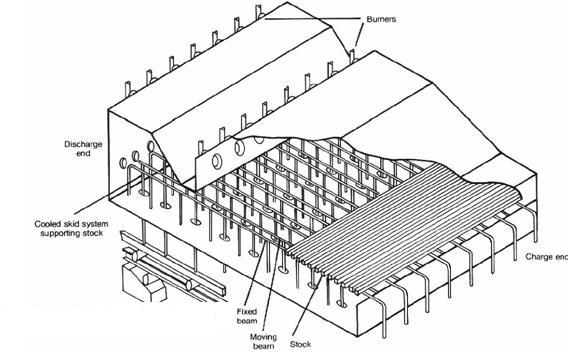
The most important and unique feature of walking beam design is the uniformity of heating across length and cross section of the material. The mechanism is designed to lift and moves the steel material step by step through the furnace. This motion ensures each billet, bloom, or slab is evenly heated on all sides, with no skid marks, maintaining consistent temperature distribution. Uniform heating minimizes internal stresses and prevents temperature-related defects, ensuring superior metallurgical quality and improved surface finish.

Flexibility

The Walking Beam Furnaces are suitable for a wide range of steel grades and product dimensions. Whether reheating long products, slabs, or blooms, the furnace can adapt to different production needs. The flexible control of heating zones and temperature profiles allows operators to fine-tune the process according to specific steel grades—making it equally effective for all steel grades hearting including speciality steel, Mild Steel and Stainless-Steel material reheating in the same furnace.

High efficiency

Walking Beam Reheating Furnaces are designed for optimal thermal performance. They utilize advanced combustion systems, waste heat recovery units, and efficient insulation to minimize energy loss. Th oxidation losses in the operation of the furnace are minimum. The combination of regenerative or recuperative burners significantly reduces fuel consumption, leading to lower operating costs and improved energy efficiency. This high thermal efficiency contributes directly to sustainable and cost-effective steel production.

Low maintenance

The mechanical components of a walking beam system operate smoothly with minimal friction. Because the steel is lifted rather than pushed, wear and tear on the furnace hearth are greatly reduced. This leads to lower maintenance costs, less downtime, and extended equipment life. The possibility of billet / Slab rotation or movement is minimum. The design also allows easy access for inspection and servicing, enhancing reliability and productivity.

Key Considerations for SS Steel production

For stainless steel, precise temperature control and a clean heating environment are essential. The walking beam design prevents surface scratching and oxidation, ensuring high-quality SS billets and bars with excellent surface finish and mechanical properties. The accurate flame length and consistent temperature control across all furnace zones is critical. Managing the furnace atmosphere is especially important in stainless steel reheating. Controlled oxygen levels prevent scaling and surface oxidation, maintaining the cleanliness and quality of the steel surface.

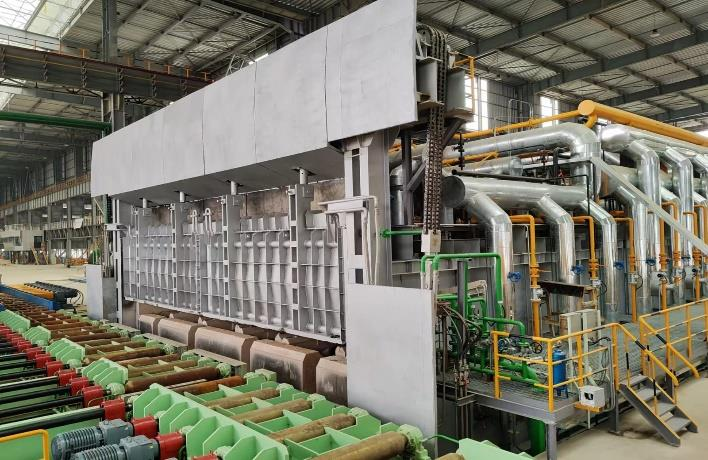
Integration of coal gasifier with walking beam CADRE – RHF POWERHOUSE Reheating Furnace

In today’s steel industry, the focus is steadily shifting toward sustainable and cost-effective energy solutions. One of the most innovative advancements in this the usage of Clean and Cold Coal Gas which can be generated from the local Indian coal. The important step in the development of same in India is the integration of a Coal Gasification with the Walking Beam Reheating Furnace. This combination not only improves the overall thermal efficiency of steel reheating operations but also
significantly reduces fuel costs and environmental emissions.

A coal gasifier converts solid coal into coal gas, a mixture of carbon monoxide (CO), hydrogen (H₂), and methane (CH₄), which is then cleaned of the impurities like tar, dust and sulphur. The resulting gas contains fewer particulates, lower sulphur content, and reduced greenhouse gases. The clean gas burns more efficiently and cleanly compared to other fuels. When used as a fuel for reheating furnaces, this gas ensures better combustion control, uniform heat distribution, and reduced fuel wastage. The result is lower energy consumption per ton of steel produced and improved operational consistency across the furnace zones.

Coal gas has a lower carbon intensity than solid coal combustion, which translates to reduced CO₂ and particulate emissions. Additionally, the controlled combustion process produces less smoke, dust, and unburned carbon, helping the steel plant meet stricter environmental regulations. This integrated system also minimizes the formation of scale and oxidation on steel surfaces, improving product quality while maintaining cleaner furnace conditions.

Founded in 2000, Shanghai Cadre Industrial Furnace Co., Ltd. (CADRE) is a leading enterprise specializing in EPC for metallurgical industry furnaces and kilns. With five R&D and engineering centres located in Shanghai, Beijing, Shenyang, and Anshan, and three manufacturing bases in Anshan, CADRE employs nearly 300 professional R&D engineers and 300 skilled technical workers. The company’s integrated capabilities span design, equipment manufacturing, project management, and on-site construction.

Over the past 25 years, CADRE has successfully executed more than 1,000 projects across China and overseas, maintaining a 100% success rate. The company holds multiple national patents, has received provincial and ministerial-level science and technology awards, and is recognized as a National High-Tech Enterprise. With the largest industrial furnace manufacturing facility in China, CADRE can produce up to four to five complete walking beam furnaces per month, ensuring strict quality and delivery standards.

CADRE pioneered dual-regenerative combustion technology for low-calorific-value gas and single-regenerative technology for high-calorific-value gas, achieving industry-leading energy efficiency and ultra-low NOx emissions. CADRE operates advanced industrial experimental platforms and continuously develops next-generation technologies such as low-NOx burners, full-oxygen combustion, and modular furnace construction methods. The company holds essential qualifications for metallurgical design and construction, along with ISO 9001, ISO 14001, and ISO 45001 certifications, ensuring compliance with global standards of quality, safety, and environmental management.

DEV ENERGY – COAL GASIFICATION

DEV ENERGY is the hub for innovation and since 2001 we have been implementing solutions for efficiency and productivity enhancement in the steel, glass, aluminium and ceramic industries with over 300 systems operating successfully saving crores for our users. We pride ourselves on providing complete tailor-made turnkey solutions.

We have 24 years of experience in the domain of Coal Gasification and have undertaken most of India’s first projects for Coal Gas generation. The system, processes and the equipment are designed and engineered by experienced and professional engineer from India and China.

Technology Advantages

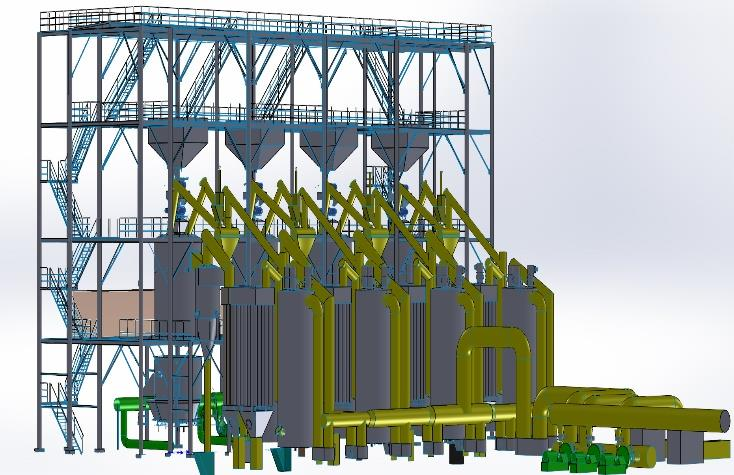
The heart of the technology is the double stage gasification process where the Volatiles in the coal are separated in the Upstage reactor and the fixed carbon in coal is converted into the carbonised gas. The purification process uses seven stages of cleaning and cooling of gas with three stages of closed cycle indirect cooling including air cooler and indirect water cooler are used to cool the gas. The two stages of electrostatics precipitation are used to clean the gas of tar. Dust is removed by cyclone. The seventh stage of sulphur removal is done using desulphurisation tower.

The need for water scrubbing is eliminated and all cooling is done without direct contact with water. This eliminates generation fresh water in to phenolic water. A specially designed heat exchanger is used to vaporise the condensate moisture and phenols which are injected back to the gasifier. This technology of reusing the phenolic water helps save energy and uses the phenolic water back in to the system. The technology complies with the norms of pollution control board. The system is designed for 100% water and steam reuse and no water of any type is discharged outside the system limit making it a zero-discharge system.

The tar produced by the process of dry electrostatic precipitation is at low temperature and free of moisture. This tar is a high-quality tar with CV > 8500 Kcal / Kg.

Process Flow Diagram

The technology because of its non-contact nature making it much safer to operate. It is also very user friendly for and provides consistent performance. The automation helps to continuously monitor the quality and quantity of gas which feed the Algorithmic based programming to increases the overall efficiency of the system.
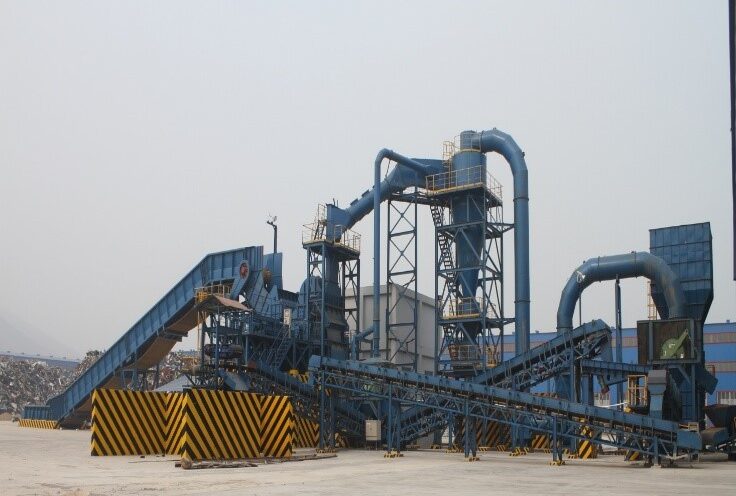
The safety of the system is ensured with a combination of fast cut off valves with high-speed vents for gas release and a highly responsive signal interlocking system programmed into the PLC system.

The clean gas improves the life of the furnaces and the burning systems.

Walking Beam Reheating Furnaces integrated with Clean Coal Gasification is a solution that bring together everything steel producers need today — a lower fuel bill, better control on heating, reduced emissions, and a stable, predictable operation. The system makes it easier for steel plants to deliver high-quality steel at lower costs while meeting sustainability goals. As India’s steel industry prepares for a new phase of growth, this combination offers a clear, future-ready solution. With a strong foundation in engineering and proven gasification expertise, DEV ENERGY is proud to support this transition and help steelmakers move confidently toward cleaner and more efficient production.

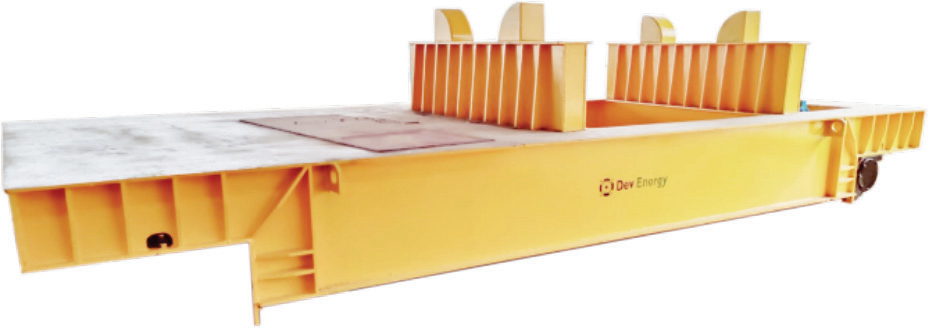
Integrating Air Pollution Control with Feeding & Melting in Induction Furnances

By UncategorizedNo Comments

Introduction

Steelmaking has been one of the most polluting industries since ages. Today, steel melting shops are under increasing pressure to meet stringent environmental norms set by the National Green Tribunal and State Pollution Control Boards. There has been no design innovation in the management of air pollution for the induction furnaces which are the mainstay of the steel making in secondary steel sector in India. The conventional solution with side hoods and scrubbers often captures only about 60% of emissions, falling short of compliance and incurring high operating costs due to heavy energy consumption.

Dev Energy, in collaboration with our Chinese technology partners, has developed through iterative innovation an advanced Fume Extraction Systems. The advantages of the system is that it captures > 95 % fumes in primary hood and eliminates the need for secondary system. The dust collected is dry containing Zinc proving the user great source of revenue. The integration to the scrap-handling and molten transfer solutions makes steel production cleaner, safer, and more commercially viable.


Let us examine the key features of the solution step by step

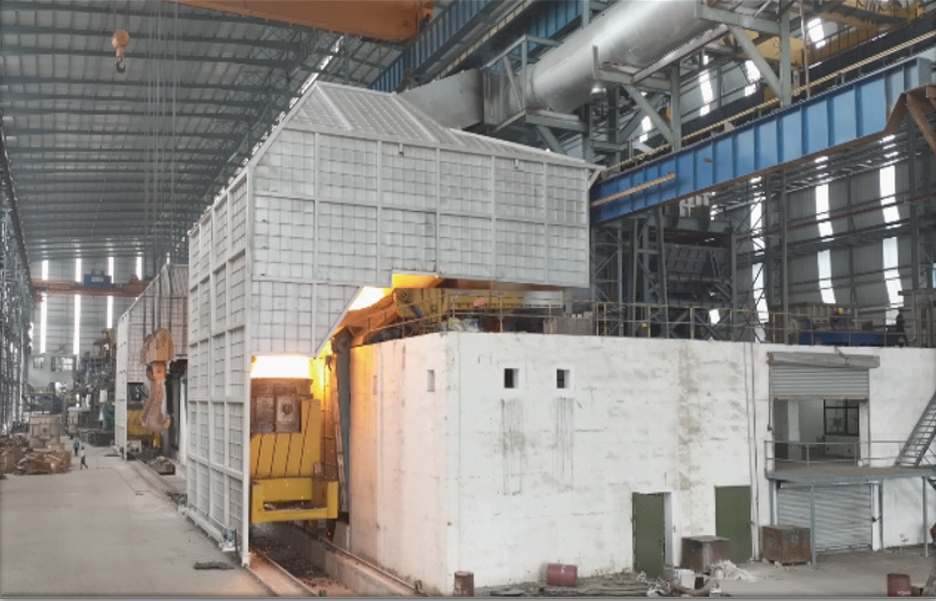
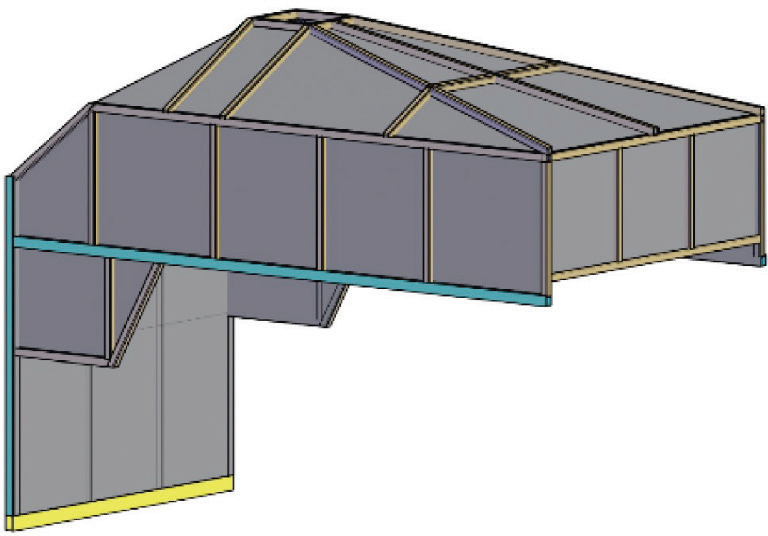
Dog House – Complete Fume Capture

One of Dev Energy’s flagship innovations is the Dog House, a specially designed hood that completely covers the induction
furnace and the feeding system. The suction of the fumes is from the top of the hood enabling easier flow dynamics of the fumes.

The Dog House has the following features
• Fume suction Capacity >95%
• One Single hood for both crucibles• Design compatible with Scrap feeding trolleys
• Design compatible with Scrap Pusher


The maximum fumes are generated with the molten metal is poured from induction furnace to the transfer ladle. The Dog House design is compatible with pouring of Molten Metal into the Ladle Car within the Dog house capturing all the generated fumes.
The Dog House is movable on its own gantries and thus need no overhead cranes. The Dog House is lined and painted with specially developed Heat-resistant paint which has resistance up to 1200 C.


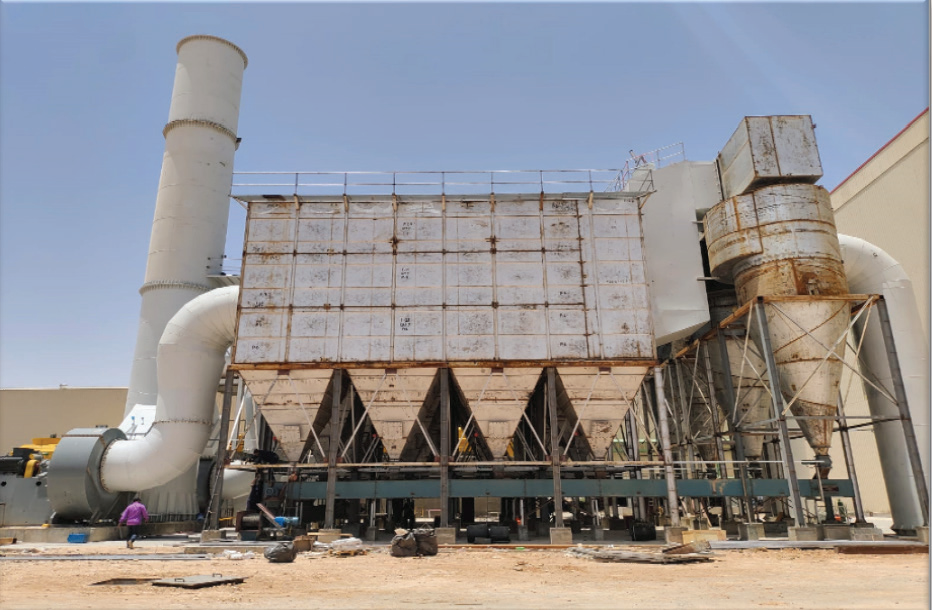
Bag House Filtration – Low pressure suction

The complete system design is based on low pressure suction enabling the system to consume very low power per ton of steel produced. The induced draft fan creates low pressure continuous suction capturing all fumes generated during melting, slagging, and tapping operations.

The dust-laden fumes are directed to a dry filtration Bag House where fine dust and metal oxides are removed.

The SPM levels at chimney outlet can reach below 30 mg/ Nm³ which are compliant to the most stringent norms in India.

The total system optimization reduces the power consumption to ~10 kWh/ton. The most important innovation to the Air pollution management for Induction furnaces is the development of Zinc extraction from the dust. The design of Bag House allows the dust recovery of ~ 0.5% of molten metal.

The collected dust, rich in Zinc Oxide, can be sold to recovery units at around ₹30 per kg, creating a new revenue stream which is sellable at ~₹30,000 per ton giving a revenue of Rs 150 per ton of Molten steel.

By combining environmental compliance with revenue generation, the Dog House system has become a sustainable solution. Our innovative solution helps capture ~ 95% fumes and reduce the cost of operating the pollution control Systems by making the dust collected sellable, which returns the capex within a year.


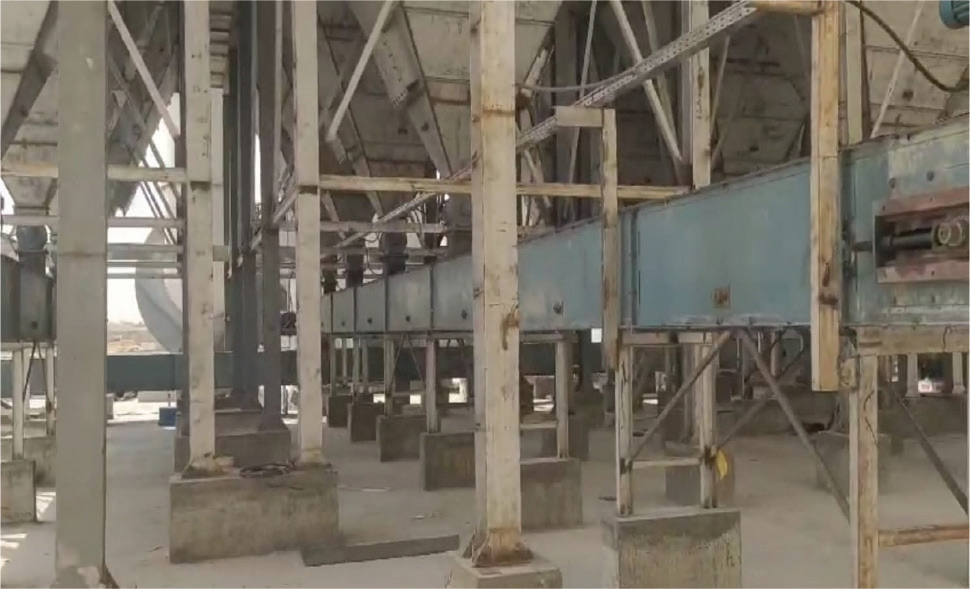
Dusting Removal with enclosed Conveyors

The value of the dust has forced us and the SMS plants to innovate on the handling & storage methods of the dust. In order to improve the collection percentage of the dust per ton of steel we developed and installed box-type dust conveyors.

These conveyors are designed for very fine dust. The design is for the fully enclosed outer structure to prevent dust escape. The overall spillage and material loss is minimized. The end result is clean shop floors and larger recovery of sellable dust.

Integrated Scrap Handling & Automation

The role of effective and efficient scrap feeding is critical for consistent melting rates and energy efficiency. If the Air pollution system is not compatible with the same, the operator will compromise on the pollution standards. This has been the story of Indian secondary sector for decades. We at Dev Energy design the Dog House system and engineered multiple automated feeding solutions for scrap handling to eliminate manual intervention and crane dependency while enhancing the operational excellence and productivity.


Scrap Feeding Trolley

The usage of specially designed Trolley which is suitable for both Scrap and DRI feeding makes the SMS feeding operations consistent, automated and eliminate the use of magnet with overhead cranes.

These trolleys are designed for hydraulic tilting force and remote-controlled operations. Their traverse speeds are ~30 m/ min. The trolleys are available in 3-ton and 5-ton one time feed capacity. The layout can be designed for trolleys to travel from front to back or back to front or side to side travel for flexible shop layouts.

The main point of design is to eliminate the need to remove the Dog House during scrap or DRI charging and the constant feeding of material into the furnace without extremes.


Vibro Charger

Similar to Trolleys, we have designed the vibro charger where the feeding is by vibrational movement of the floor. The constraint in selection of Vibro chargers is that the scrap should be completely shredded or sheared.


These chargers are able to transfers scrap into furnaces smoothly and safely into the furnace. They are better at providing the melting stability, reducing the safety risks and ensuring controlled feeding.

Scrap Pusher

The efficiency of Induction furnace is dependent on the meting rate and feed rate of the scrap and DRI. The only impediment in the maximization of same is the bridging at the mouth of the furnace. Scrap Pusher is innovative Hydraulic system with a telescopic boom to push the scrap into the furnace.


The system provides long stroke with small footprint. It offers benefits like increased reach in space constrained areas with high pushing force power. It is designed to complement the Dog House by operating within the required space and height while improving melting rates and more scrap per melting feeding cycle.


DRI Feeding System

The Induction furnace need constant feeding of Sponge Iron (DRI) and thus Dev Energy has developed a conveyor-based system. This system stores DRI in a hopper and transfers through covered conveyors, silos and vibro chutes. It enables safe, continuous and oxidation-free charging of DRI.


Ladle Transfer Car - Molten Metal Handling

Once molten metal is ready, it is safely transferred from the induction furnace to the caster using a ladle transfer car. The maximum fumes are generated in the transfer operation. Therefore. It is mandatory to have the Dog House operational and parked above the Induction furnace at the time of pouring of Molten metal


The ladle car is thus mandatory for operating furnace within the Dog House. This eliminated the operations by cranes where the ladles are transferred by overhead cranes. The final result is zero fume leakage during pouring and safe dust-free transfer of molten metal.

Conclusion

The success of modern steelmaking in efficient melting with sustainable operations. Dev Energy’s end-to-end solutions— from the scrap transfer and charging to fume extraction and dust recovery to molten metal transfer — integrated seamlessly to deliver higher productivity, lower operating costs, and assured environmental compliance.


Dev Energy has positioned itself as a trusted partner for SMS operators by combining practical knowledge, advanced engineering with automation to deliver cleaner, smarter and more profitable steel production.


Dev energy CEO Mr Varun jindal interview

By UncategorizedNo Comments

Dev Energy stands at the forefront of innovation, dedicated to enhancing efficiency and productivity in India’s steel, ceramics, and non-ferrous industries. With a robust portfolio of over 200 systems operating successfully, the company has established itself over the past 24 years in the field of coal gasification, pioneering many of the nation’s first projects focused on coal gas generation.

In an exclusive interview, Varun Jindal, CEO of Dev Energy, shares his journey in revolutionising coal gasification technology in India. Conducted by Santosh Mahanti, Editor of Iron & Steel Review magazine, the discussion explores the objectives behind establishing Dev Energy, a company committed to optimising energy solutions across various industries. He talks about the innovative two-stage gasification technology developed by the company, highlighting its significant impact on cost efficiency in the steel and ceramics sectors. The interview also emphasises Dev Energy’s mission to transition industries towards cleaner and more economical fuel alternatives, providing insight into the future of coal gasification in India and its potential to reshape the industrial landscape

What inspired you to start Dev Energy?

Every great idea starts from a seed, and in my case, that was the problem that no one seemed to be solving at that time – the process of using cheap coal to replace expensive fuels. India is abundant in coal; however, no major industry was using it in 2003 as a fuel. That’s why I searched for the best coal gasification technologies in the world and found the same being used in China extensively. It felt like a smarter, cleaner, and more economical way to use our domestic coal resources. It was about making the best use of what we already have – coal – while providing no-compromise technological solutions to the industry.

Dev Energy was built around that idea. I wished for us to become a complete solution provider, helping industries transition to efficacy, efficiency and cost competitiveness and replacing the expensive imported fuels and draining us of precious foreign exchange.

What is coal gasification, and what’s the value proposition for the user?

Coal gasification is a technology that converts coal into a clean, versatile fuel called coal gas, which can be used as fuel to heat furnaces of steel mills, ceramic tile plants and any other industry that needs heat. The complete coal gasification and gas purification process through our plant is able to harness the energy in coal in the form of gas and segregate the harmful tars, phenols and ash. The driver for me has been to create a strategic shift for my customers by being cost-competitive. I genuinely believe that coal gasification is a bridge between today’s realities and tomorrow’s future. It’s about securing energy independence and creating jobs, all while being commercially viable.

How is Dev Energy’s gasification technology offering different?

Dev Energy’s gasification technology deals with the gasification process in two stages, with volatiles in coal being converted to gas in the upstage reactor and the carbon in coal converted to gas in the downstage reactor in the presence of steam and air. The reaction is at very high temperatures, making it the most efficient conversion in the industry. The two-stage technology provides an immense advantage in gas cleaning and purification. The proprietary 8-stage cooling and cleaning process cools and cleans the gas of dust, tar, phenols, moisture, sulphur and other harmful particles. The process is accompanied by a proprietary reuse process of phenolic water, making the complete system Zero Liquid Discharge and compliant with the NGT norms for coal gasification in India.

What industries are you targeting for coal gasification?

Our focus has always been on industries where heat is a big part of the operating cost, and directly switching to coal firing isn’t practically possible. Therefore, the primary target has been the steel industry, with reheating furnaces and pellet plants being major consumers of heat. These furnaces were operating on furnace oil and stood to save 50% of their fuel cost by shifting to coal gasification. Next, the ceramic industry was in focus with wall tiles, floor tiles and tableware being made by natural gas or LPG, providing an opportunity to shift to clean and cheaper coal gas. In the last 23 years, we have successfully commissioned more than 200 plants, and 85% of them are in the above-mentioned industries. Many other applications remain untapped, such as chemicals like TiO2, non-ferrous melting shops, and alumina calciners, which are still using very expensive fuels.

Which projects have been your hallmark of success?

I feel that luck is an opportunity that meets preparation; therefore, I have been very lucky. The strength of a technology enterprise is measured by how many times it has been a first mover. We have the distinction of being the first in India to have successfully commissioned coal gasification for Ceramic Tableware at the biggest brand Clay Craft, Ceramic Tiles at the famous brand Kajaria Tiles, 240 tph Steel Reheating Furnace at Jindal Steel & Power, 14 USER Coal Gasification Plant at Tata Steel (Tayo Rolls), Straight Grate Pellet Plant at Minera Steel & Power, Grate Kiln Pellet Plant at Ankit Metal & Power, Stainless Steel Slab Reheating Furnace at Rimjhim Stainless and many more. We have been able to successfully envision and execute these projects with our deep understanding of process, design, engineering and implementation.

How do you envision the future of coal gasification in India?

I feel the coal gasification in India is in both arenas – Fuel and Syngas.

In fuel usage, the Indian industry has understood the reality of coal being cheaper than other alternative fuels, and if they choose the right technology, the adaption of coal with no resultant harm to the environment will be possible. The latest technologies, like Air-fed Circulation Fluidised Bed (CFB), will enter India as they can use coal fines and have zero tar and phenol footprint.

In Syngas, coal is the base raw material, which can be converted to expensive raw materials like hydrogen and ammonia to produce valuable chemicals like methanol, DME, synthetic natural gas and fertilisers. The Syngas can be used as a direct reductant in the DRI-making process, removing the need for imported coking coal.

We at Dev Energy are part of this journey, offering CFB-based technological solutions that make sense for both arenas, helping India’s transition into a future without dependence on imports.

What is Circulating Fluidised Bed (CFB) technology?

Circulating Fluidised Bed (CFB) coal gasification technology uses the process of conversion of coal fines into carbonised gas by creating a cloud of coal fines and oxygen under high pressure and temperature. The operations are just below the Ash Fusion temperatures of coal, and thus, ash is not melted. The process is made efficient through multiple loops of circulation of coal till the carbon is fully converted. The process is best suited for gasification of light bituminous and sub-bituminous coal as they are softer and with high reactivity. The plants are simpler than other competing technologies.

How does it address the challenge of using high-ash Indian coal?

The Indian coal is mostly available with high ash content, and thus, the future technology must be able to perform on it. Our CFB technology has the inherent advantage of operating range of pressure and temperature which allow the carbon conversion without the problems of agglomeration. The optimum pressure and temperature suitable for the Indian coal allow the CFB gasifiers to use coals with up to 30% ash content on an ADB basis. The same has been tested and proven in many lab-scale and commercial plants.

What is the challenge for coal gasification to be successful in India?

If we as a nation want coal gasification to take off in India, I think a few realistic and practical policy changes are required. You must understand that projects like these need heavy upfront investment, and long-term policy clarity gives businesses and investors the confidence to plan big. The first key step is to ensure that the coal is available at the right price and with long-term supply assurance for consistent quality and quantity. Secondly, we need to make all project approvals, including environmental clearances, smoother without cutting corners on safety or environmental checks but by simplifying the process and cutting down unnecessary delays. The steel industry will benefit hugely from these two steps as the Syngas to DRI process is a proven technology waiting to be implemented in the right ecosystem. The third step for other products would be to build a proper market around products made from Syngas like methanol, DME, SNG, ammonia, and hydrogen. If we have a clear pricing framework or guaranteed offtake model in place, industries would be far more willing to invest in gasification projects.

How do you see the National Coal Gasification Mission influencing your roadmap?

The National Coal Gasification Mission is a very timely intervention by the Government of India. It’s encouraging to see the government actively supporting cleaner, more efficient ways of using our domestic coal resources. For us at Dev Energy, it feels like the larger ecosystem is finally catching up with a vision we’ve been working towards for years. This mission isn’t just about policy, but it’s about creating real opportunities on the ground. The senior officials are open to any discussion or feedback in framing and execution of the policy. The structure of Viability Gap Funding is intelligently designed to enable public sector and private sector participation. I believe that 15% VGF on the total Capex should excite many players to jump on the coal gasification bandwagon. It gives us, as Dev Energy, the confidence that we’re building the future in the right direction and the support to think even bigger.

How do you think the adoption of coal gasification happened in the steel industry in India?

I believe that the lowest hanging fruit in the Syngas arena is the use of Syngas as a reductant in the DRI-making process. The large public sector or private steel players should get together and set up the smallest viable commercial-scale project of 0.8 MTPA with assured coal as part of the National Coal Gasification Mission. The capital cost of the project can be optimised by first spending on study and detailed engineering of the process and equipment with the aim to convert 75-80% into make in India. The indigenisation of the technology should be a prime objective with a target to multiple deployments on success.

What are the biggest leadership lessons you’ve learned while building Dev Energy?

Building Dev Energy has been a constant learning experience of my life. I realised early on that leadership is not about having all the answers, but it is about listening, asking the right questions, and trusting your team. The toughest part of being a leader for me has been to let go of control. In the beginning, I was and wanted to be part of every decision, every detail. But as we grew, I realised that the best thing I, as a leader, can do is to build a strong team, give them a clear direction, and then step back and let them run with it. In the last 23 years, I also learnt that it is okay to fail. Not everything I tried worked; some ideas flopped, some deals didn’t happen. But those moments taught me much more than the easy wins ever did. Now, if there is one thing I truly believe — it is that people follow values, not positions. Being honest, staying grounded, and genuinely caring about your people and your purpose makes all the difference. That’s what I try to remind myself of every.

What are the key timeless values you think are the cornerstone of Dev Energy?

I have driven Dev Energy by a set of core values that guide all our decisions and actions. These serve as the mile markers on the highway of success for us.

Honesty is being transparent and open in all work practices. All stakeholders, suppliers, employees or our customers are bound to each other by trust. This results in empowerment at all ends.

Excellence is a way of doing things. We do our best to upgrade our skills and knowledge.

Innovation is constantly pushing for better ways to serve. We are always thinking out of the box of unique solutions to solve challenges. This proactive approach puts us ahead of all others.

Reliability is to embrace ownership of tasks assigned to us. We strive in our goal to create a product that meets customers’ expectations 100%.

What advice would you give to young entrepreneurs interested in clean tech innovation?

My advice to anyone entering or navigating this arena would be to not give up on how tough or slow it feels at times working in this industry. There are no overnight success stories. It takes time, it takes patience, and sometimes it feels like there is no light at the end of the tunnel. But if you stick with it, the impact you’ll create will be something you can truly be proud of. Also, be very clear about why you’re doing it. Clean tech sounds exciting, but it comes with its own set of challenges. You need to be passionate about solving real problems, not just chasing trends. And don’t wait for the perfect idea or perfect time. Start small, ask lots of questions, and spend time in the field. Most good ideas come from paying attention to problems no one else is looking at. Lastly, find people who share your values and believe in the future you’re working towards. It makes the journey a whole lot easier and a lot more meaningful.

How has Dev Energy extended its footprint into related areas?

In the last 23 years, I have been interacting with many technology companies all over the world, and our clients keep asking for our help in solving various challenges. We have, in the process, developed and deployed technologies in the following fields.

Scrap Processing

Deteriorating steel scrap quality necessitated the preparation of scrap for melting through scrap processing machines for better efficiencies in melting furnaces. Processed steel scrap is denser and cleaner for faster charging in the furnaces. Dev Energy has developed expertise to provide innovative turnkey solutions for efficient scrap segregation, processing and feeding. The scrap is processed using three broad methods, namely Shearing, Baling and Shredding. The machine selection depends on the type of raw steel scrap, its density, size, cleanliness level, size of the furnace, power density of the furnace, etc. There are various types and sizes of machines available to process scrap from 01 to 100 t/hr.

Fumes Extraction System

The present devices can only absorb up to ~60% of emissions and cannot fulfil government standards. Because they are intended for exceptionally high working pressure, their operating costs are quite expensive. Dev Energy developed and deployed a Dog House-based fumes extraction system for induction furnaces, collecting more than 95% of the fumes, and total power usage is ~10 kwh/t. Scrap Pusher compliments the Dog House system to help SMS furnaces achieve the required melting rate. Scrap Charging Trolley, which is remotely controlled, helps feed the scrap to furnaces without the need for the Dog House to be moved.

Reheating Furnaces

The heating cost of steel is a major component in the making of rolled steel. Efficient reheating furnaces are the need for the hour. Dev Energy has partnered to provide efficient walking beam furnaces with regenerative burner technology. The furnaces can be designed on any fuel such as coal gas, blast furnace gas, natural gas or mixed gas.

Smarter Scrap Processing: Enhancing Efficiency in Melting Furnace

By UncategorizedNo Comments

Why is Scrap Processing Important?

Deteriorating scrap quality has necessitated the preparation of scrap through scrap processing machines for better efficiencies in melting furnaces. Processed scrap is denser and cleaner for faster charging in the furnace.

Processed scrap also consumes less power per ton of steel produced, resulting in high productivity for the furnace. Dev Energy scrap solutions can be tutored to plant needs and help processors manage any type of input scrap; while increasing scrap value and employee safety through efficient of scrap handling. We proudly provide robust industrial shredders and shears in the market today. Our systems not only make scrap easier to manage, then low-cost operations reduce waste thus lowering the total cost and providing immense value to the company.

Application Impacts

Steel making is a very competitive business. The secondary steel manufacturers have to be efficient and their cost has to match the primary producers who make steel from Iron ore. The secondary steel making process has to use the Electric Arc or Induction Furnaces to make molten steel. In India about 45% of the steel is produced using Induction Furnace with the use of two basic raw materials Sponge Iron and Scrap Steel.

Dev Energy - Benefits

  • Power Consumption LOWER BY ~ 15 %
  • Heat Time REDUCTION BY ~ 20 %
  • Increase in Production Per Heat Unit
  • Increased Life of Furnace Lining
  • Reduction in Slag Formation
  • Reduction in Scrap Purchase Cost
  • Less Fumes & Cleaner Environment

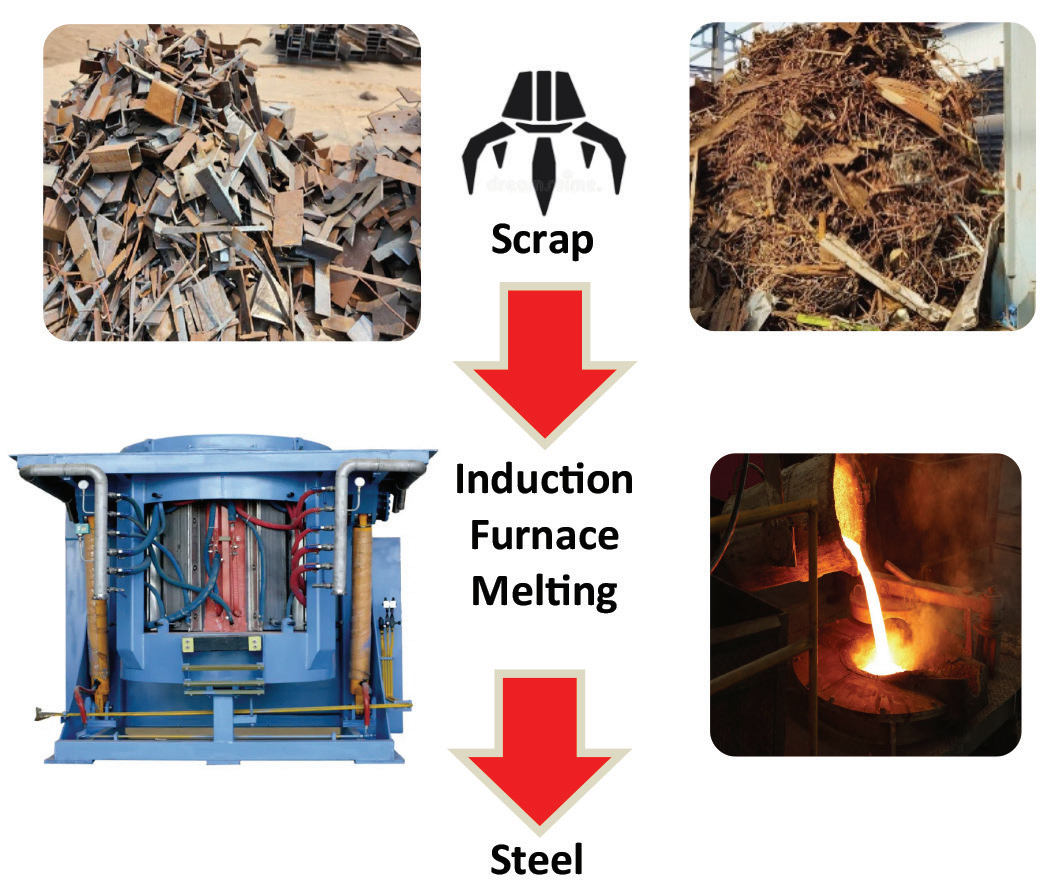
Main Process – Scrap + Induction Furnance

End to End Solutions

These factors can be achieved with streamlining the total process to the desired results. To start with, the purchase of the right kind of raw material suitable for the furnace and the end product need to be identified.

SMS using Scrap as the main raw material face a major challenge as the scrap is never consistent and it is impossible to define parameters for processing it. The complete process from scrap purchase to melting need to be aligned to the desired results.

Dev Energy has developed expertise to provide innovative turnkey solution for efficient scrap segregation, processing and feeding in the furnace. This feeding system also has to be integrated with the pollution or Flue control system generated during melting.

Power is the major cost in making steel. Dev Energy has been actively working on reduction of power with its dynamics and interrelation to scrap processing. The scrap shape, density and size are the variables that determine the time required for melting. The input scrap that is improper results in longer time for melting and higher power consumption.

Offerings

The solution is to process the scrap in the proper parameters using machinery matching the type of scrap.

The scrap can be processed using three broad methods namely Shearing, Baling and Shredding. The process identification depends on the type of Raw Steel Scrap, its density, its size, its cleanliness level, the size of the furnace, power density of the furnace etc. There are various types and size of machines available to process scrap from 01 to 100 t/hr.

These scrap processing machines must accompany with matching scrap unloading and segregation system. Once the scrap is processed the system design should be able to feed the same to the furnace. Dev Energy provides the complete range of turnkey solutions for unloading and segregation, processing scrap and the material handling systems for feeding scrap.

The perfect implementation results in reducing the power consumption up to 8% and heat time up to 10% resulting in net cost saving of 10%.

Processed Scrap Targets

Final Density > 1000 Kg / m3,
Size < 600 mm,
Dust ~ Negligible

Machine Selection

Shredder

Output density to 2 ton/m², ≥ 99% metal recovery in process, Non-Ferrous segregation, Bag House De-Dusting system, Z Box Air-cleaning system.

Lowest operation cost ~ INR 650 / t

Flexible Soution Offering

Sound Proof Enclosure, 2nd Magnetic Separator, Blue Smoke Inhibitors, Video monitoring system, Man Shorting conveyor.

Box Shear

Ideal for all variety of Scraps, Three sides of compression, Additional side press & clamping, Output Scrap Density ~ 1000 Kg/m³

Operational Expenses ~ INR 250 / t

Multi-Blade Shear

LID compression and top clamp compression, Size of shearing < 500 x 500 mm (5 Pieces), Output scrap density ~1000 kg/m³, Ideal for medium & heavy scrap

Low operation cost ~INR 90 / t

Straight Bed Shear

Output Scrap Density ~ 900 Kg/m³, Automatic Blade Tightening, Side Compression & top clamp compression, Option of Lid cover / Feeding bucket

Low operational cost ~ INR 100 / t

Container Shear

Ideal for Medium & light Scrap, Simple operation of horizontal shearing, Output Scrap Density ~ 700 Kg/m³

Low operational cost ~ INR 100 / t

Alligator Shear

Ideal for Long and Heavy Scrap, Manual Operation

Low operation expense ~ INR 50 / t

Continuous Baler

Continuous operation, Three sides compression, Bales density up to 3 ton / m³, Output Speed ~ 100 bales / hr

Large Baler

Three sides compression baler, Automatic PLC Driven Operation, Cycle time ~ 120 sec, Fully hydraulic driven operation, Option for Centre / Side FLIP out

Low operation expanses ≤ INR 75 / t

Crane

360 Rotation arm, 30 sec cycle time, grad capacity ~ 0.9 m3, stationary and mobile machine with Diesel or electric option.

Dev Energy provides all these combined solutions which delivers value for money to end user in one package.

Dev Energy – Projects

Three sides compression baler, Automatic PLC Driven Operation, Cycle time ~ 120 sec, Fully hydraulic driven operation, Option for Centre / Side FLIP out

Scrap Procssing Unit – Green Steel

Based on bench marks of various primary and secondary steel making process with optimized solution using effective scrap processing as mentioned here not only delivers techno- commercially effective solution but also makes move towards Green Steel lower emissions in rage of 0.6 to 0.8 CO2 t / t of Liq. Steel.

As closer to targeted by global standard for Green Steel definition value of 0.4 CO t / t of Liq. Steel.

Conclusion

Dev Energy with its successful EPC/Turnkey project design and implementation is a proven solution provider. Dev Energy has delivered successful projects for > 23 years and is committed to Sustainable Scrap Processing Solutions. With exclusive global partnerships already in place, DEV ENERGY can deliver 3R’s REDUCE, REUSE and RECYCLE.

Coal Gasification- A Sustainable & Innovative Heating Solution

By UncategorizedNo Comments

A Sustainable & Innovative Heating Solution

Coal gasification is a process captures thermal & chemical energy of coal into gaseous components methane (CH4), Hydrogen (H2) and Carbon monoxide (CO) which can be used for Industrial heating applications. This process offers several advantages over traditional coal combustion which involve handling of solid coal, residual ash and unburnt carbon. The direct exposure to the coal is not possible in many production processes.

The Coal Gas produced from air-fed gasifiers delivers clean gaseous fuel with the ash of coal, tar and unburnt carbon remaining in the gasifier as residue.

The cost of fuel per unit of energy varies from coal being cheapest then moving higher to furnace oil, High speed diesel, Natural Gas, Propane & LPG. In the last 25 years, the average cost of energy from coal has been 50 – 70% lower than these fuels.

Coal Gasification therefore offers Indian Coal as a suitable replacement for all industrial heating applications like steel, ceramics, glass etc. as an alternate technically feasible, proven technology and cheaper solution than traditionally expensive fuels like furnace oil, natural gas and Propane.

In the Steel Industry all heating applications like Reheating furnace, Annealing furnaces, Iron ore dryers and pelletisation require large amount of heat which can be sourced from Coal Gasification at almost half lower cost of fuel for economic and competitive solution of steel making.

Why coal Gasification For Pellet Plants ?

Pelletisation need a large amount of heat energy for drying of the wet Iron ore pellets. Since, in India most of these pellet plants are designed on expensive fuels like furnace oil or natural gas the cost of manufacturing Iron ore pellets becomes very high which makes Indian pellets less competitive in the global market.

Global Pelletization Fuel Usage Treands:

In China, Iron ore palletisation plants are designed with coal gas or mixed gas as fuel which results in their cost of manufacturing being very low. Similarly, Brazil based Iron ore pelletisation plants are designed for natural gas as Brazil has large natural gas reserves making the cost very low. But, in India pellet plants are designed for furnace oil or Pulverised coal injection. Both these fuels are import based and expensive which makes Indian Pellets manufacturing process systematically expensive and less competitive in the global market.

The coal is available in India in abundance and at a cheaper cost the alternative fuels. Therefore, in order to use the domestic coal for efficiently producing Iron ore pellets, Coal gasification is the most suitable method.

From over twenty-three years Dev Energy has worked in arena of Coal Gasification and now there are many pellet plants are operational with Coal Gasification. Some of these are 2 MTPA Pellet Plant near Raipur, 0.4 MTPA pellet plant near Bilaspur, 0.6 MTPA plant in Orrisa, 0.6 MTPA plant near Durgapur and 0.6 MTPA pellet plant near Hospet in Karnataka.

Key Feature Of Dev Energy Solution:

Pelletisation - Successfull Case study:

MTPA STRAIGHT GRATE PELLET

Design Gas output: 17000 Nm³/ hr
System Configuration: 2 x 4.0 DSCG
Furnace oil replaced: 54 KL / day

Dev Energy provided a Turnkey solution to Minera Steel and Power, Bellary where furnace oil was used as a fuel in their pellet plant. Dev Energy took the challenge and replaced 100% of Furnace Oil with Coal Gas. This resulted in the “World’s First Straight Grate Pellet Plant on 100% Coal Gas”.

Technology Advantages:

The technology uses seven stages of cleaning and cooling of gas with three stages of closed cycle indirect cooling including air cooler and indirect water cooler are used to cool the gas. The two stages of electrostatics precipitation are used to clean the gas of tar. Dust is removed by cyclone. The seventh stage of sulphur removal is done using desulphurisation tower.

The need for water scrubbing is eliminated and all cooling is done without direct contact with water. This eliminates generation fresh water in to phenolic water. A specially designed heat exchanger is used to vaporise the condensate moisture and phenols which are injected back to the gasifier. This technology of reusing the phenolic water helps save energy and uses the phenolic water back in to the system.

The tar produced by the process of dry electrostatic precipitation is at low temperature and free of moisture. This tar is a high-quality tar with CV > 8500 Kcal / Kg.

The technology complies with the norms of pollution control board. The process uses indirect cooling and cleaning which results in no fresh phenolic water generation. The condensate phenolic water is reused in the gasification system. The system is designed for 100% water and steam reuse and no water of any type is discharged outside the system limit making it a zero-discharge system. The system is designed to capture the harmful fumes generated during process. 

Process Flow Diagram

The technology has positive impact on health and safety of the operating team because of its non-contact nature making it much safer to operate. It is also very user friendly for and provides consistent performance.
The automation helps to continuously monitor the quality and quantity of gas which feed the Algorithmic based programming to increases the overall efficiency of the system. The clean gas improves the life of the furnaces and the burning systems.

The safety of the system is ensured with a combination of fast cut off valves with high speed vents for gas release and a highly responsive signal interlocking system programmed into the PLC system.

Dev Energy provided a Turnkey solution to Minera Steel and Power, Bellary where furnace oil was used as a fuel in their pellet plant. Dev Energy took the challenge and replaced 100% of Furnace Oil with Coal Gas. This resulted in the “World’s First Straight Grate Pellet Plant on 100% Coal Gas”.

STEEL REHEATING FURNACE, JSPL
Design Gas output: 80000 Nm³/ hr
System Configuration: 10 x 3.6 DSCG
Furnace oil replaced: 250 KL / day

AGI GLASSPAC is a project where innovative solution for regenerative furnaces was implemented. Here the gas is used alternatively in two different chambers and thus in this furnace the gas is required to switch alternatively in the chambers without stopping the flow.  Dev Energy designed a proprietary automatic switch valve to overcome this challange. The valve was integrated with the furnace and gasifier automation system. This system was installed near Hyderabad.

Conclusion

Dev Energy with coal gasification as sustainable solution not only gives efficient and economical heating applications in various stages of steel making but also delivers decarbonisation by replacing the highly polluting GHGs generated from conventional e.g. furnace oil especially reducing carbon di-oxide (CO2).

The system, processes and the equipment are designed and engineered by experienced and professional engineer from India and China. All the manufacturing of equipment is in house in the modern production facilities. This ensures that the demanding quality standards are maintained without any compromise

Dev Energy believes that the success of coal gasification project lies not only in supply of the right technology and equipment, but also in providing right operational training to the team. In order to ensure the system is operated by trained people. Dev Energy provides onsite training to the operational and maintenance teams and if required also take up contracts for operating the system to ensure project’s success. The team of project managers, engineers, trained operators and specialised contractors to provide end to end turnkey solution to the industry.

Present geopolitical environment is pointing in the direction that India needs to use internal resources and reduce dependence on imports. For India, with its huge coal reserves, Coal gasification is a best alternative to reduce country’s dependency on imported fossil fuels.

Today, with many of the India’s and the World’s first innovations in the field of Coal Gasification Dev Energy is in a position to take up any challenge to convert conventional fossil fuels to coal gas for the iron and steel industry.

Circulating Fluidised Bed Coal Gasification Technology for High Ash Indian Coal – Fuel & Dri Syn Gas

By UncategorizedNo Comments

National Coal Gasification Mission

“We have set a target to gasify around 100 million ton of domestic coal by the year 2030. Coal Gas will be used in transport & cooking while urea and steel from gasification will promote manufacturing. Latest technology can be introduced to make gas from coal and environment will be protected with coal gasification” – SHRI NARENDRA MODI, Hon. Prime Minister of India.

What is Gasification?

Gasification is a robust, proven, and versatile technology that produces syn gas (carbon monoxide (CO) + Hydrogen (H2)) from reaction between carbon, oxygen and steam air at low to high pressure (atmospheric to 30 bar g) and temperature ranging from 1000oC to 1600oC.

Gasification not only captures heat but also Chemical value of feedstock like Coal.

However, Indian coal has challenges of high ash (>35%) thermal non-coking coal and high moisture (48% – 54%) lignite which calls for need most applicable technology.

Ash is removed by gravity from the gasifier and is discharged into a system for depressurization and disposal. The gasifier maintains a low level of carbon in the bottom ash discharge stream and achieves overall carbon conversions that can exceed 99%. Cold gas efficiencies of over 80% and carbon conversion of up to 99% have been repeatedly demonstrated on a commercial scale in CFB operating plants.

CFB is more fuel-flexible, utilizing low-rank and other high-ash coals, and offers higher efficiency than competing gasification technologies, due to the fluidized bed design and resulting long residence times of the reacting particles.

Fines carried over from the fluidized bed are separated from the syngas prior to heat recovery and syngas cleanup. The product syngas is essentially free of tars and oils due to the temperature and residence time of the gases in the fluidized bed, simplifying downstream heat recovery and gas cleaning operations.

CFB gasification adopts three-stage waste heat recovery process, which can recover the heat of high temperature syngas to produce high temperature and high pressure steam along with air/oxygen preheating resulting in overall high thermal efficiency.

Technology Overview

Our Partners

JINAN HUANGTAI GAS FURANCE CO. LTD.

Normal Pressure – Air Fed – Fuel

  • In Operation Since 2009
  • > 22 Operational plants
  • Higher calorific value fuel : 1250 kcal/Nm3
  • Continuous 21 month gasifier campaign

Ease of Operation & Maintenance

Shanghai Zepu Engineering Technology Co. Ltd.

HIGH PRESSURE – OXYGEN FED – DRI SYN GAS

  • Patented and improvised CFB technology
  • High Pressure – 3 bar to 40 bar
  • Proven commercial scale plants from basic engineering, detailed engineering, and EPC solutions for clean syn gas
  • Customised solution for various end-use applications such as clean DRI Syn Gas, Methanol, DME, Ammonia, Urea and SNG
  • Strong R&D in line to handle low-rank coals of high ash and moisture

Technical & Economic Advantages

Government of India Incentives

CFB is the only proven commercial-scale technology for high ash Indian coal gasification projects to benefit from all Government of India incentive schemes:

  • Viability Gap Funding (₹ 8500 cr)
  • Dedicated Coal linkages assurance
  • Notified Coal Pricing (Lower coal price than auction rates)
  • 50% rebate on captive mine dedicated to surface coal gasification
  • Coal Price GST waive off (~ 400 Rs/ton)

National Steel Mission – Guarantee off-take for steel makers

As India’s major contributing GDP National mission to grow to 300 million ton per annum steel production by 2030 from 127 million ton per annum as of 2024 to support strong infrastructure growth, steel producers will also be served by the proven commercial-scale CFB technology clean DRI syn gas from high ash Indian coal gasification projects. These projects will also be 100% Green Hydrogen compatible for coming decades as against Blast Furnace route which depends on high price of coking coal imports.

CFB Coal Gasification – “IN India FOR India”

Technology Selection – Why CFB?

   Commercial scale three technologies which are Fixed Bed, Entrained Flow and Fluidised Bed technologies below pros and cons:

Based on various interactions organised by the Ministry of Coal for the implementation of the National Coal Gasification mission it is evident that all major technology developers such as Thermax, BHEL and CSIR-CIMFR have chosen CFB starting with pilot scale as the most suitable technology for Indian high ash coal.

CFB Technology – How it Works?

Grinding, sorting, shredding, and/or drying may be required to bring the feedstock up to the gasifier feed system’s standards of <10 mm particulate size.

The prepared feedstock is pneumatically supplied to the CFB gasifier vessel, which is a bubbling in circulating fluidized bed reactor. The feedstock combines with air/oxygen and steam as gasification in the fluidized bed, uniform temperature of 1000 oC is maintained to provide high carbon conversion and non-slagging conditions for the feedstock’s ash. The CFB gasification process is carried out as partial oxidations as gasification of feedstock with agglomeration and separation of ash.

Technology Features & Advantages

Adaptability of CFB Syn Gas

The syngas is subsequently processed for use in a variety of applications, including direct reduced iron (DRI) steel production, methanol, fertilizers like ammonia, Urea, further ammonium nitrate, substitute natural gas (SNG) and di-methyl ether. Pre-combustion carbon capture CFB Gasification in syngas cleaning systems downstream of the gasification process makes it useful for CO2 removal as raw material for downstream products and potential to make it carbon neutral technology solution.

Compatibility with downstream DRI Licensors

   CFB technology has full flexibility of H2/CO ratio, CO2 removal adjustment as required by all global DRI technology providers offering wide adaptability for the complete technical and commercial optimisation for steel makers.

Flexibility of CFB offering

CFB gasification adopts oxygen-enriched gasification, and the N2 content in syngas can be effectively controlled below 5% or lower. CFB gasification pressure is high avoiding any downstream compression requirement, and the CH4 content in the syngas can be up to Controlled ideal for DRI steel-making feedstock.

Compatibility with downstream DRI Licensors

CFB technology has fully aligned requirement of H2/CO ratio, and CO2 removal adjustment as required by all global DRI technology providers offering wide adaptability for the complete technical and commercial optimisation for steel makers.

Optimized process configuration

Commercial DRI Plant – Ready for offering

0.5 MTPA DRI – Vertical Shaft Kiln

Clean DRI Syn Gas Process

CFB offers the flexibility of a partial water shift gas process unit for the downstream vertical shaft kiln. Also, this technology is capable for using wide range of O2 purity from Air Separation unit and CO2 removal unit required levels.

Conclusion

    DEV ENERGY with its successful Turnkey project design and implementation proven solution provider has delivered > 23 years and is committed to taking National Gasification mission on a fast implementation model with low capital cost using a Circulating Fluidised Bed Technology with commercial scale projects. We are also well aligned with the “Make in India” model even with China Partners as maximizing local manufacturing and minimum proprietary scope (<5%) with no technology transfer fee requirement due to Dev Energy exclusive partnerships already in place. With experienced & qualified EPC solution provider not only can coal gasification projects on fast track but also provide after sales service and operational success for sustainability of high ash Indian coal gasification with CFB.
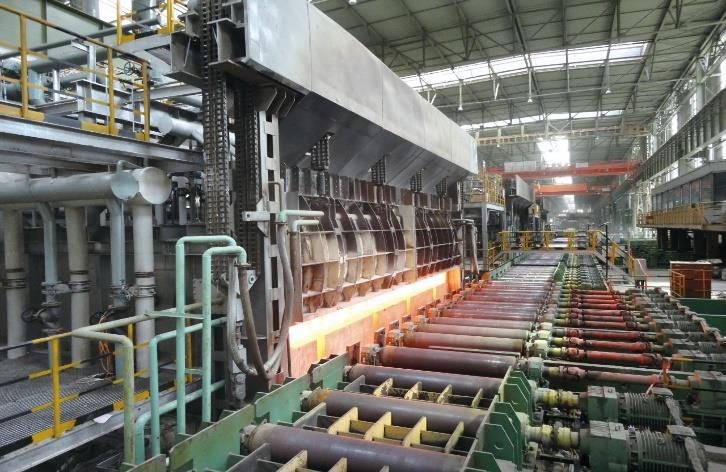
References

  1. https://pib.gov.in/PressReleasePage.aspx?PRID=1999220
  2. https://coal.gov.in/sites/default/files/ncgm/ncgm21-09-21.pdf
  3. https://www.netl.doe.gov/carbon-management/gasification#:~:text=Gasification%20enables%20remediation%20of%20wastes,net%2Dzero%20energy%20system%20basis.
  4. https://pib.gov.in/PressReleasePage.aspx?PRID=1944388